
What is the ultimate goal of Samvel Karapetyan’s new party?
July 15 2025, 19:40
Samvel Karapetyan, a businessman and philanthropist currently under arrest, has announced the formation of a fundamentally new political force in Armenia. According to him, the rally held on July 4 confirmed the government’s main fear—that the people are confident in their strength and will not back down under pressure. “We will follow our own path with our new team, including political cooperation with like-minded allies,” he said.
Karapetyan’s announcement is a logical continuation of the statement made on July 4, in which he stated the following: “Nikol Pashinyan and his government have no future in Armenia and should not be associated with the future of the Armenian people. I am ready to follow the path of struggle for the sake of our country and our homeland, which no one will develop or protect for us.” The only way to ensure that Pashinyan and his government have nothing to do with the future of Armenia is to achieve political change through involvement in the political process.
Judging by the statement and the preceding process, Karapetyan is creating a large anti-Pashinyan party. In fact, this is bad news for both Pashinyan and his domestic and geopolitical sponsors, who are already talking about the imminent opening of the “Zangezur corridor” under the guise of a 100-year lease of a section of Armenian territory to an American company.
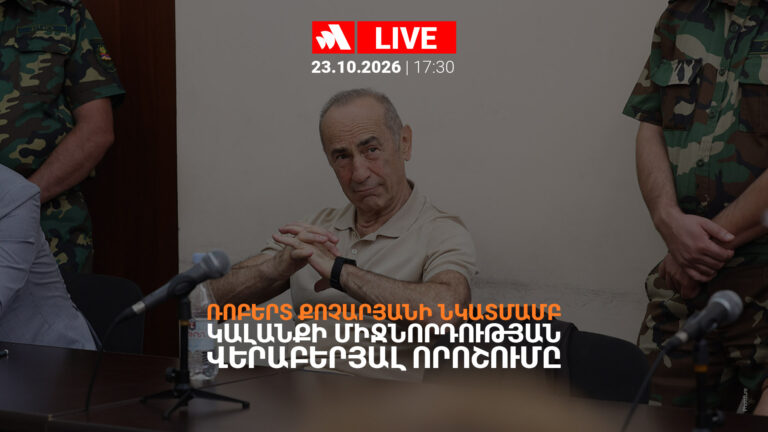
This creates a second real, large, and self-sufficient center of resistance to Pashinyan, after the Armenia bloc led by Robert Kocharyan. This further increases the likelihood of repeating the strategic approach seen in the recent Gyumri elections, where opposition groups participated independently while maintaining a “political truce” and later forming a broad coalition.
It will not be surprising if some segments of the “opposition” will soon join attacks on Karapetyan since they will undoubtedly lose their “place under the sun” if Karapetyan manages to create a large, independent, and self-sufficient political pole. The slim chances of gaining at least 5% in the upcoming elections will become even more unrealistic.
At the same time, it is obvious that Karapetyan and other significant political actors need to take into account the fact that Pashinyan may provoke post-election unrest if defeated—similar to the events of 2008. Moreover, the topic of increased discussions and processes surrounding the “Zangezur corridor” indicates that in such a scenario, the “civilized world” and Turkey, which is not very civilized, will support any actions taken by Pashinyan. When planning politically, it is worth taking into account that, unlike in 2018, the opposition will not have “competitors” in the government who wanted to hand over power themselves. Whether through early elections or regular ones, no one is going to hand over power voluntarily. Samvel Karapetyan and others involved in the political process must clearly understand this. The stakes are too high…
Think about it…
 Now live