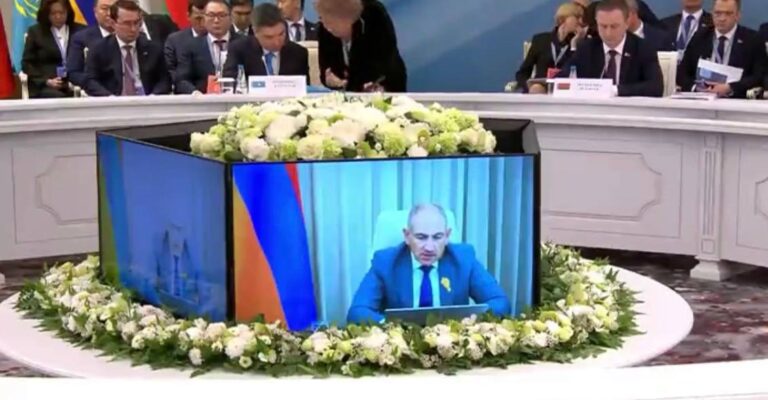

Lavrov’s signals to Pashinyan and Armenian people
February 04 2026, 19:00
The situation surrounding Armenia today resembles a complex chess match, where the pieces on the board are mere figures, while the true grandmasters sit in offices thousands of kilometers away. Recent statements by Russian Foreign Minister Sergey Lavrov and news from Brussels highlight a dangerous paradox: the West demands from Armenia what it categorically refuses to accept for itself on security grounds, while Turkey openly seeks to absorb the country.
Lavrov’s latest remarks were strikingly blunt. His core message is that the 102nd base and Russian border guards are not simply “leased land in Armenia,” but the foundation of security for the entire South Caucasus. Moscow conveys the position that Russia’s presence is a key deterrent against destabilization in the region. In this context, Armenia’s border with Turkey is effectively the border of Russia/CSTO with NATO, with all the resulting consequences.
The Russian side also directly points out that the legitimacy of Armenia’s internal processes must not be replaced by external directives. Lavrov’s reference to the “Moldovan scenario” of elections is a clear signal that falsification of electoral processes under Western supervision is unacceptable to Moscow. At the same time, it is emphasized that the doors of the CSTO remain open, and Armenia’s full return to active participation in the organization primarily serves the interests of the country itself.
Lavrov openly describes US and EU activity in the region as “cold calculation,” aimed at inflicting a “strategic defeat” on Russia. In this view, Armenia risks turning from a political subject into a mere “pressure point” that Russia’s geopolitical opponents can exploit at will.
Particularly striking is the comparison with Brussels’ own position. Just days ago, AP quoted Kaja Kallas opposing the creation of a Europe-wide army while NATO exists. Her argument was disarmingly honest: one cannot build a parallel security structure, otherwise one risks ending up between two fires. Here lies the central irony: for itself, the EU admits that trying to sit on two chairs in defense matters leads to chaos. It chooses NATO as a single umbrella structure to avoid diluting resources and provoking loyalty conflicts.
Yet the same West actively encourages Yerevan to “diversify,” which in practice means drifting away from the established security system toward vague promises. Thus, the very logic of “two fires” that Europe fears is deemed perfectly suitable for Armenia by Brussels. Yerevan is effectively being pushed into a situation that Europeans themselves describe as “unthinkable” and “dangerous.”
The tragedy of the moment is that, due to the statements of an irresponsible political elite, Armenia has become a geopolitical apple of discord. Prime Minister Pashinyan declares a move toward EU standards while maintaining membership in the Eurasian Economic Union “as long as possible.” But Moscow warns: this may end instantly if the West proceeds to a direct military “reprogramming” of the region. Diversification must not turn into “friendship against third parties.” Especially since the West offers Armenia no real “umbrella” comparable to NATO but eagerly exploits its distancing from Moscow. In the resulting security vacuum, Armenia risks being absorbed by Turkey.
Ultimately, the country is urged to leave one security system without being given any guarantees in another. This is precisely the path “between two fires” from which Kallas so carefully warns Europeans, but which is being actively imposed on the South Caucasus.
Think about it…
 Now live