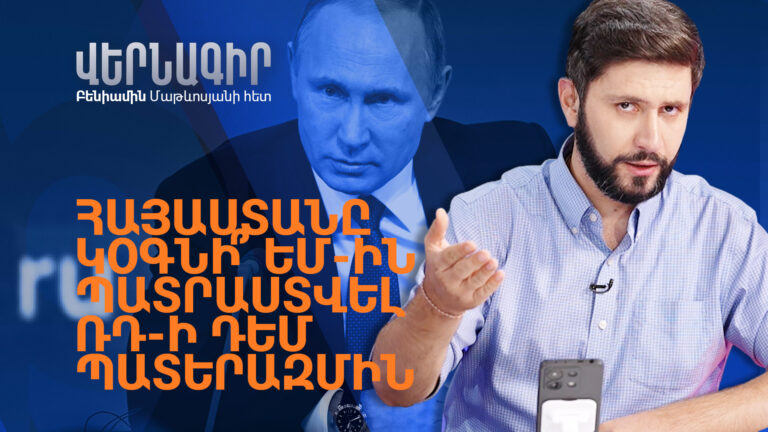

Beniamin Matevosyan: Will Armenia help the EU prepare for war with Russia?
September 10 2026, 12:30
(Here’s why Putin is insisting on a referendum)
The news that Volkswagen’s car plant in Osnabrück, Germany, is being repurposed has become a vivid symbol of the deep changes taking place in Europe. The plant is ending production of civilian vehicles and, in partnership with the Israeli company Rafael, is switching to manufacturing components for air defense systems. This is not an isolated episode but part of a broad trend sweeping across key European states. In France, the Renault group, together with Turgis Gaillard, is preparing serial production of the AAROK heavy reconnaissance-strike drone, and along with Thales plans to produce thousands of Toutatis kamikaze drones per month. Similar processes of rearmament and the restructuring of industry onto a war footing are underway in the United Kingdom as well.
All these facts add up to a clear picture: the European Union and its allies are systematically and seriously preparing for a potential direct military confrontation with Russia. Europe’s economy is gradually shifting into a militarization mode, in which civilian production capacity is being handed over to the needs of the defense sector. Military analysts and politicians in Brussels no longer hide the fact that they are considering a scenario of long-term confrontation requiring enormous volumes of weapons, equipment, and ammunition.
If one looks at the current geopolitical situation through the lens of this inevitable EU militarization, the logic behind the Kremlin’s actions on the Armenian track becomes entirely clear. Moscow views Yerevan’s European trajectory not merely as political maneuvering by Nikol Pashinyan, prime minister, but as Armenia’s direct entry into the orbit of a bloc that is openly restructuring itself for war with Russia. Under these conditions, the demand for Armenia to hold a referendum by the end of the year and to withdraw legislative initiatives on EU membership takes on fundamental significance for Moscow.
Statements by Dmitry Peskov, press secretary to the Russian president, that Vladimir Putin and Pashinyan will discuss the choice of Armenia’s strategic direction of development and the holding of a corresponding plebiscite, only confirm the firmness of the Kremlin’s position. Russia no longer intends to subsidize, protect, or grant economic preferences to a country that, in the event of a large-scale conflict, would find itself in the enemy camp.
Moscow’s calm attitude toward the European integration of individual states is a thing of the past, today, EU integration is perceived in the Kremlin as joining the military-industrial cooperation of Russia’s adversaries. From this follows an important conclusion: no diplomatic concessions, compromise rhetorical formulations, or attempts by Yerevan to stall for time will make Putin abandon his basic demand for a referendum.
For Moscow, this issue has moved out of the category of South Caucasus domestic politics and into the sphere of global security. Yerevan has effectively been issued an ultimatum to fix its status, since continuing to balance between a Moscow and a European Union being reshaped for military needs will become impossible under the new realities.
Think about it…
 Now live