
“The devil is in the details”: TRIPP or “Zangezur corridor”? Alexander Konkov
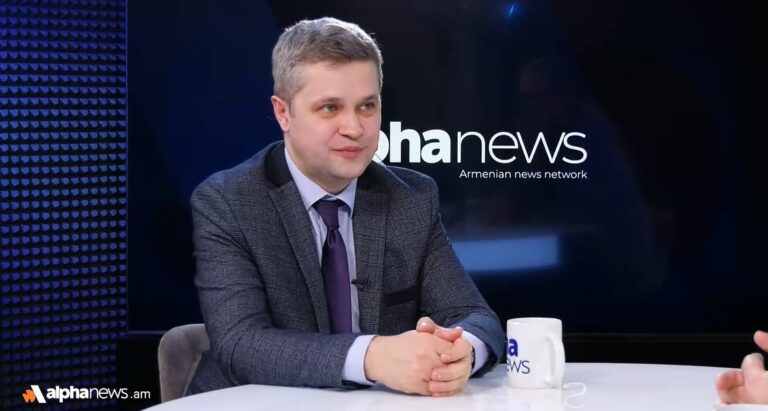
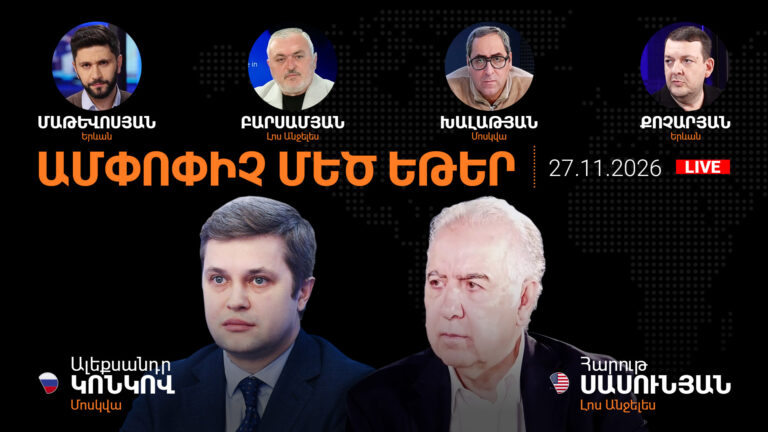
Alexander Konkov, associate professor at the Department of Political Science at the Financial University under the Government of the Russian Federation and candidate of political sciences, commented in an interview with Alpha News on Armenian Prime Minister Nikol Pashinyan’s upcoming December visit to Russia, as well as on Russia’s relations with the US and Europe and the possibility of the conflict in Ukraine expanding.
“The process is ongoing, actually, and after the first, April meeting there was a lot of aftertaste: people discussed whether an agreement was reached or not. Apparently, everyone still holds certain positions on the fact that the process is under way. But it seems to me that the Russian position in this regard is fairly consistent. Whatever is good for the Armenian people, let it be. But then certain norms come into play, certain rules provided for by documents, certain principles laid down, in particular, in the structure of an international organization, if we are talking about the EAEU.
So I think, in principle, no concessions should be expected. We will see what Pashinyan brings to Moscow, what proposals there will be, and whether they will be public. Here, too, perhaps not everything will be clear right away. Obviously, some bargaining is going on, and there are obvious attempts to cross a hedgehog with a grass snake, that is, to combine the incompatible. But at all levels, the Russian side and the EAEU as an organization say that these two projects, European and Eurasian, are incompatible. So one can look for a formula, but, in principle, none exists right now,” Konkov said.
According to the expert, Armenia’s accession to the EU is unlikely, and if Yerevan departs from its economic obligations within the EAEU, Russia will be forced to respond on a domino principle by cutting off the basic economic freedoms: the movement of goods, services, capital and labor.
“The idea of European integration for Armenia is a pie in the sky. And in the EAEU there is an absolute bird in the hand, which, given the indicators, has practically become a crane itself: all the benefits are plain to see. If obligations are met, everything works as before. But if they are violated, above all in the economy, zero hour comes: a switch is flipped, and all opportunities are shut off. The rhetoric with which the Armenian side comes to the negotiations looks like an attempt to agree on something. But here everything is mathematical: one can promise anything. Russia will believe in and count on its partner’s goodwill until the last, as it always has. However, as soon as there is a real departure from obligations, not in words but in deeds, a different logic will kick in on the domino principle, affecting all four economic freedoms: the movement of goods, work, services and capital, with all the ensuing consequences,” Konkov said.
Speaking about the TRIPP project, the expert noted that Armenia, Azerbaijan and Turkey interpret its content differently, and that unblocking transport routes must take into account the interests of all participants in the region.
“Building bridges and roads is always better than building walls, so logistics and integration projects can only be welcomed. But the devil is in the details: few people have any idea what the TRIPP project is today. There are only general slogans voiced more than a year ago. It is unclear how it will be implemented on the ground and combined with other routes. The trilateral talks initiated by Russia clearly linked the end of the Armenian-Azerbaijani conflict to the unblocking of all transport routes. Now, when talking about TRIPP, only the southern part is discussed: Azerbaijan’s connection with its exclave through southern Armenia. But what about the other communications, which are still blocked by the Azerbaijani side? The sides’ approaches still diverge: what Yerevan considers the TRIPP project, Baku and
Ankara see differently and stubbornly call the ‘Zangezur corridor,’ knowing Armenia’s negative reaction. For now the project exists only in rhetoric, and Russia’s position is that the interests of all participants must be taken into account,” Konkov concluded.
 Now live