
A Most Toxic Office: How Armenia’s ‘High’ Commissioner of Diasporan Affairs Sows Division, Discontent, and Disinformation Across Communities and Continents Pt.1
December 30 2025, 12:46
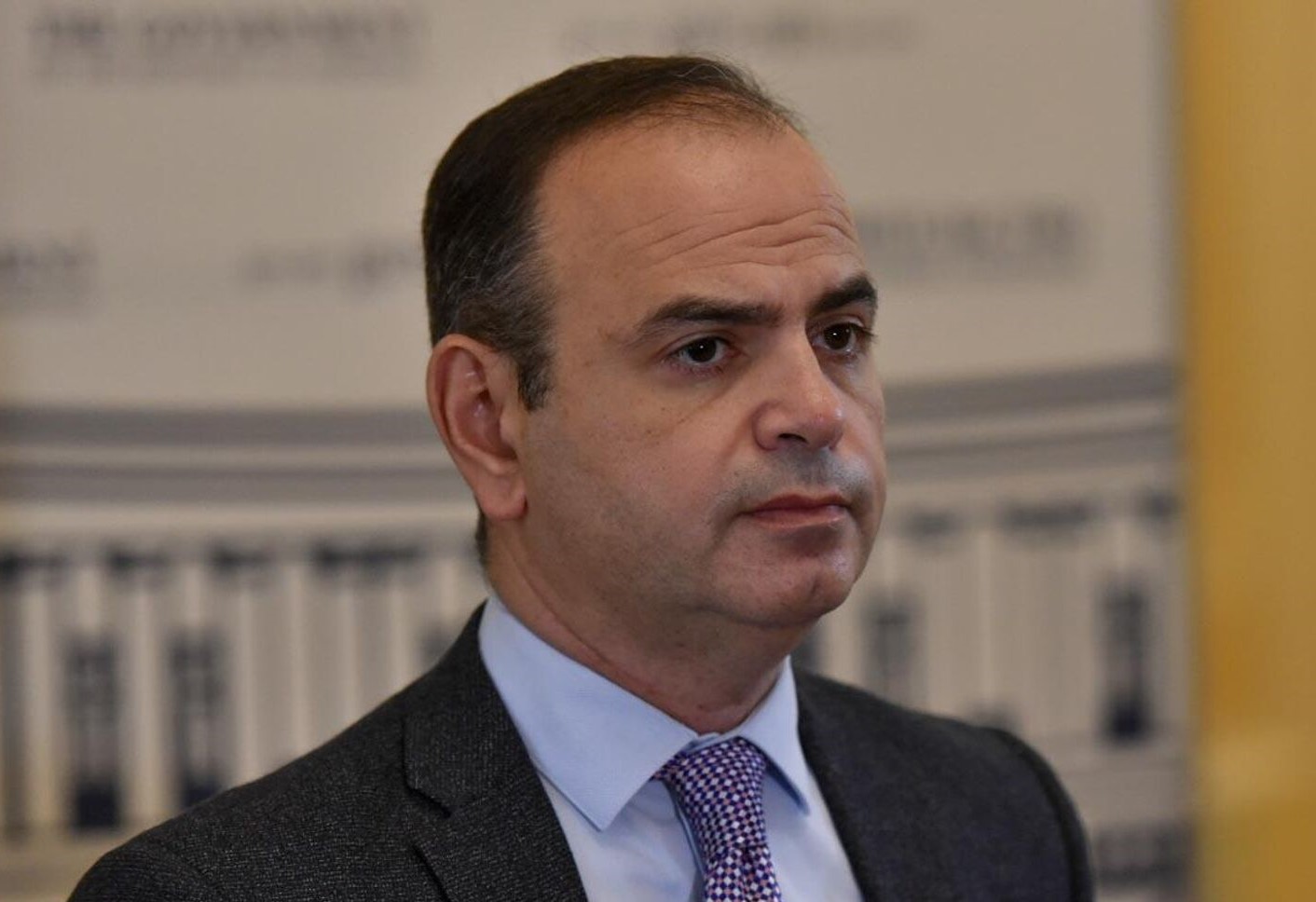
“Whoever controls the Diaspora controls the future of the Republic of Armenia”—
an idea well understood by the official responsible for Diaspora affairs, Zareh Sinanyan.
By Garen Chahe Jinbachian
Recently, inside a university lecture hall in Los Angeles—the U.S. city with the largest concentration of Armenians outside of Yerevan—Zareh Sinanyan, “High Commissioner for Diaspora Affairs of the Republic of Armenia,” held a closed-door, “informal” meeting with Armenian university students. Fewer than a dozen Armenian Students from a few different universities gathered discreetly to engage in dialogue with the visiting official from Yerevan.
These students, members of the All-ASA and UCLA ASA, belong to a cohort actively working for the restoration of rights for the Indigenous Armenians of Artsakh. They are young people who seize every opportunity to bring international attention to plots against their Homeland and to violations of human rights. They are the same individuals who sacrifice personal comfort to serve organized community life, striving—often against overwhelming odds—to effect even modest improvements in Armenia’s grim reality.
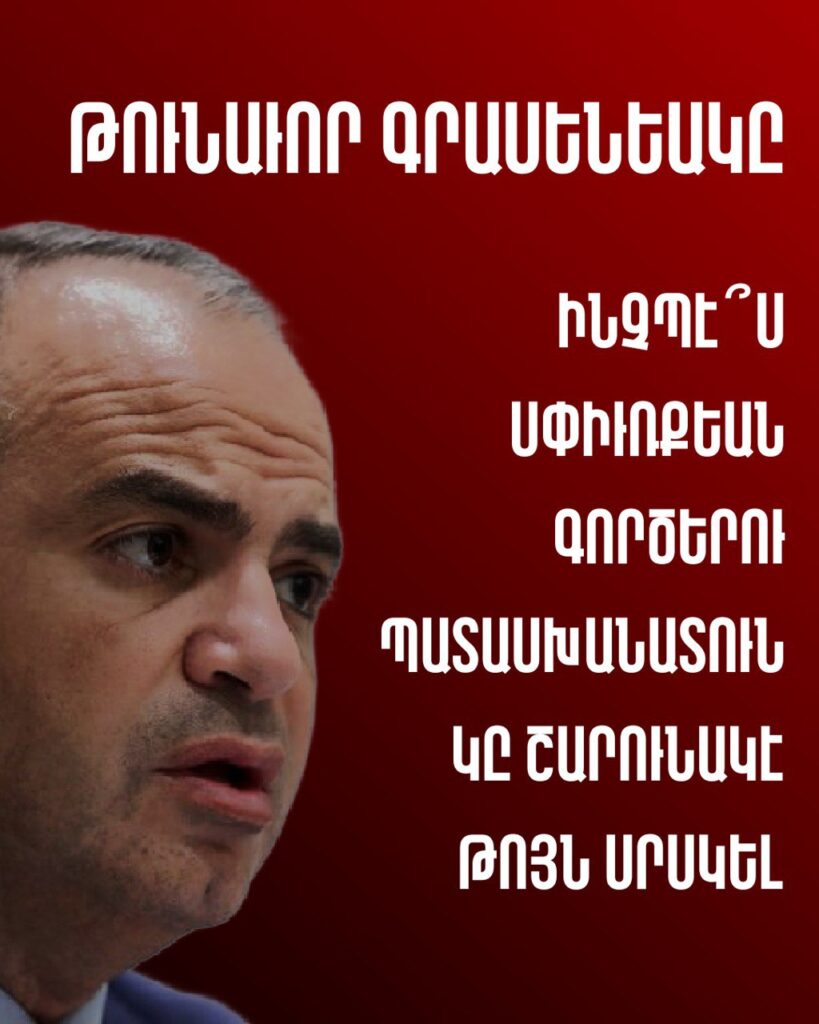
The students entered the meeting expecting encouragement and inspiration—hoping the encounter would strengthen their resolve and commitment for the betterment of the Republic of Armenia. Instead, those expectations quickly dissolved as they were confronted with what they describe as “premeditated, pro-Turkish messaging:” the normalization of defeat, the dismissal of the issue of Armenian prisoners of war and political detainees, the abandonment of long-standing national interests, the rejection of Christian values, and the renunciation of national consciousness.
A Shift in Tactics: From Open Forums to “Behind Closed Doors”
Zareh Sinanyan, the Republic of Armenia’s so-called “High Commissioner for Diaspora Affairs,” seems no longer able to conduct his activities in large public venues. Instead, he has been forced to shift towards smaller scale meetings with carefully selected audiences—particularly students. One plausible explanation for this strategic shift is the sustained and increasing opposition his public interactions have faced over the years. By operating behind closed doors, resistance is preemptively neutralized, and opportunities for public scrutiny or exposure of falsehoods are reduced dramatically.
Rather than serving as a bridge between the Republic of Armenia and the Diaspora, Sinanyan is actively contributing to its erosion and weakening. He has become a leading Diaspora-facing figure in a campaign to erase the Artsakh issue from public consciousness, acting as an obedient instrument of Prime Minister Nikol Pashinyan’s political and financial agendas.
Appointed to his position in 2019, Sinanyan has, since, consistently disseminated misinformation and divisive narratives that fracture the Diaspora instead of mobilizing it in support of Armenia’s political life.
Once a Son of the Diaspora, Now a Servant of a Discredited Power
Sinanyan began his political career within the Armenian National Committee (ANC) of Burbank, California, using its networks and resources to pursue higher political ambitions in the United States. In 2013, he ran for Glendale city council, leveraging the institutional backing of the ANC’s longstanding Armenian advocacy structures to gain visibility and support.
Ironically, many of the very organizations he now denounces were instrumental in allowing him to enter the political landscape.
However, Sinanyan’s day in the sun was soon eclipsed when, during his 2013 campaign, a slew of social media posts surfaced exposing a darker and most disturbing side of his desperately cultivated political persona. These posts, whose provenance was never in dispute, even by Sinanyan himself, contained highly offensive and inflammatory racist, religiously discriminatory, misogynistic, and generally hateful comments and threats.
The scandal severely damaged his political prospects in the U.S., alienating both Armenian and non-Armenian communities. Political allies withdrew their support en masse, turning the local politics freshman into a seasoned failure, in short order.
Initially attempting to ignore the controversy, Sinanyan ultimately issued a public apology once silence was no longer a viable option. That apology effectively marked the end of his American political career.
Blocked and marginalized in the U.S., Sinanyan relocated to Armenia in 2019, where he was absorbed into the Pashinyan administration and appointed High Commissioner for Diaspora Affairs—a role, seemingly, tailored for him, given his familiarity with Diaspora organizations, particularly those that had once supported him.
However, his new mandate, instead of strengthening the bonds of Homeland and Diaspora, became the dismantling of those very structures: sowing discord, undermining the Diaspora’s historical strength, and casting doubt on generations of work dedicated to the vision of a Free, Independent, and United Armenia.
An Office Transformed into a State-Funded Disinformation Hub
An institution that should have served the preservation of Armenian historical and cultural heritage, the global recognition of the Armenian Genocide, and the support of repatriation efforts has instead—under Pashinyan’s leadership and Sinanyan’s execution—been transformed into a state-funded mechanism for disseminating falsehoods.
The Infamous Meeting with Armenian Students: Four Messages of Disinformation
During the meeting with Armenian Student Association members, Sinanyan reportedly sought to transmit four key messages:
a. “Artsakh Is Not Ours—Close the Chapter.”
Artsakh was presented as territory outside Armenia’s concern, a subject to be forgotten entirely. Advocacy for Artsakh was labeled extremist and dangerous to the Republic of Armenia.
b. “The Release of POWs and Political Prisoners Is Secondary.”
Sinanyan repeatedly minimized the urgency of securing the release of Armenian prisoners of war, missing persons, and political detainees subjected to torture and abuse in Baku’s prisons.
c. “Peace Requires Concessions.”
Unilateral concessions were framed as acts of “courage” rather than betrayal. Those continuing to demand Armenian rights and defend Armenian statehood were portrayed as extremists and criminals.
d. “The Diaspora Has No Role in Armenia’s Politics.”
With bitter irony, the Diaspora Affairs Office—rather than drawing upon decades of Diasporan political experience—pursues its exclusion from Armenia’s political life. The long-familiar message of “send money, but stay out of politics” is, thus, repackaged and reinforced.
A Call to Resistance
When Sinanyan speaks, one could mistake him for a Turkophile, Azerbaijani propagandist whose sole objective is the weakening of Armenian statehood and the demoralization of the Armenian people. His rhetoric enables Azerbaijani crimes—genocidal acts and human rights violations—to go unanswered, paving the way toward Armenia’s national erasure.
Some students remained silent, fearing exclusion from future meetings. But, those who spoke out—who voiced principled concern, challenged the government’s course, and rejected the Diaspora Office’s posture—are praised here unequivocally.
History will judge accordingly: silence will be forgotten; resistance will be remembered.
Conclusion
Today, Armenians face a grim reality in which the “High Commissioner for Diasporan Affairs” does not represent the Diaspora, but serves as a conduit for the current government’s toxic policies that buttress the strategic interests of foreign powers and continued personal gain for the ruling elite.
Emerging from the Diaspora, yet scarred by political and personal failures, Sinanyan now threatens Armenian unity—particularly by targeting youth.
Resistance is no longer optional; it is vital—our youth and our futures are at stake.
Salvation lies in collective strength, not in divisiveness and betrayal, and certainly not in the destruction and erasure of Armenian indigenous rights and cultural values.
The duty of all Armenians, in the Homeland and in the Diaspora, is abundantly clear: to reject pro-Turkish, destructive anti-Armenian narratives, no matter the messenger; to relentlessly demand the right of return for indigenous Armenians to Artsakh; the release of political prisoners and hostages; accountability for genocidal Azerbaijan’s crimes against humanity; global recognition and reparations for the Armenian Genocide, and the continued pursuit of a Free, Independent, and United Armenia.
 Now live