
Armenia in hypothetically worse situation, losing territory and positions in South Caucasus – Boris Rozhin
November 01 2025, 14:28
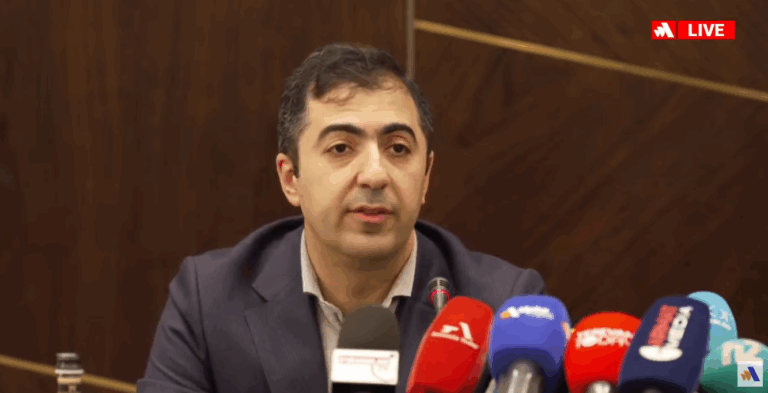
Speaking with Alpha News, Boris Rozhin, an expert at the Russian Center for Military and Political Journalism, commented on the risks of the opening of the Armenian-Turkish border and the establishment of diplomatic relations announced by Armenian Prime Minister Nikol Pashinyan, the risks for Iran and Russia of the creation of a Turkish-Azerbaijani buffer zone in southern Armenia, the implications of the “Trump Route” for the South Caucasus, and the Armenian Prime Minister’s visit to France.
According to the expert, the opening of the Armenian-Turkish border and the establishment of diplomatic ties are part of Pashinyan’s state policy of normalizing relations with Turkey—even at the expense of Armenia’s national interests.
“It’s no coincidence that before Pashinyan, the Armenian authorities were reluctant to establish cross-border corridors or open the border with Turkey, and so on. This policy lasted for decades, and Pashinyan decided to change it, including by ceding territory and opening up the possibility of establishing cross-border corridors. He is already, to some extent, a hostage to this position: he won’t be able to reverse it, because for several years he’s been assuring Armenia that this is the only possible course, and thatprevious approaches were wrong. Under these circumstances, he can no longer reverse course and abandon this policy, because he’ll be asked the reasonable question: why did you do all this? So he will push through to the end. This concerns the territorial corridor from Nakhichevan to Azerbaijan, which will provide Turkey with access to the Caspian Sea, as well as the opening of the border with Turkey. At the same time, Turkey doesn’t consider Armenia a friendly country, but rather sees it as a platform for expanding its influence in the Caucasus. Naturally, Azerbaijan is interested in Armenia continuing to follow this course, because this allows it to obtain various concessions and benefits without the need for direct military action,” Rozhin said.
According to the expert, the opening of the corridor strengthens Turkey and Azerbaijan, but weakens Armenia.
“Armenia is consistently losing not only territory but also the positions it held in the South Caucasus before Pashinyan. Now the situation is hypothetically worse: Karabakh and the border regions have been lost, and the country is effectively being forced to open a cross-border corridor that strengthens Azerbaijan and Turkey. Armenia gains almost nothing from this—it primarily serves Turkey and the Turkic world, including Azerbaijan and Central Asian states. In return, Armenia finds itself even more dependent on Turkey and Azerbaijan, which continue to make territorial claims. The term ‘Western Azerbaijan’ continues to be used even in official statements from Baku. A weak state with guaranteed borders depends on the goodwill of external players—Turkey, Iran, Russia, the US, and the EU. With the previous world order crumbling and international treaties systematically violated, this weakness threatens Armenia’s very existence and the future of the Armenian people. This is also reflected in migration: more and more people are leaving, seeing no prospects under the current government,” Rozhin noted.
According to Rozhin, the “Trump Route” project is seen as a move by the United States to expand its influence in the region beyond Turkey and the EU.
“It’s clear that the ‘Trump Route’ project poses risks for Armenia. This is confirmed by official statements from Russia and Iran. The project is seen as a move by the United States to expand its influence in the region beyond Turkey and the EU, establish a foothold in a region traditionally dominated by Russia and Iran. An extraterritorial corridor will be perceived as a potential threat to traditional spheres of influence.
If forces are pushing a corridor through your territory under threat, what kind of security can we talk about?” Rozhin concluded.
 Now live