
Beniamin Matevosyan: no Armenians, no problem — the essence of Azerbaijan’s statements
April 01 2026, 19:40
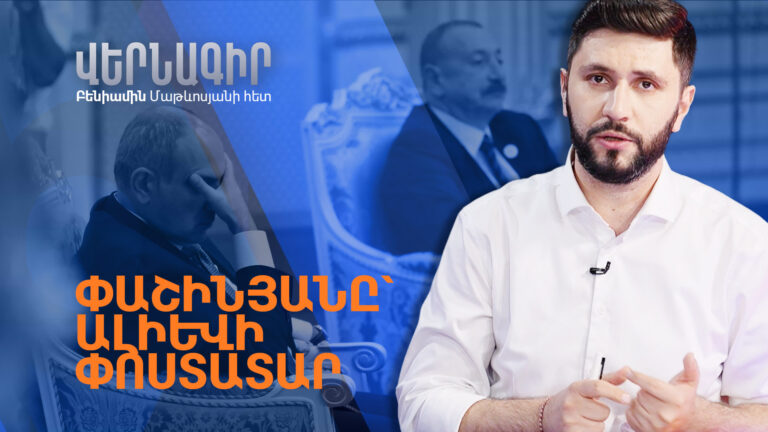
(Pashinyan is Aliyev’s postman)
The “blank slate” policy being imposed on Armenian society today by Prime Minister Nikol Pashinyan is not merely a diplomatic strategy, it is an attempt at rewiring of national consciousness on fundamental level. Stripping a nation of its historical memory turns it into a passive subject, driven only by instincts of consumption and survival.
The current prohibition on using terms like “ethnic cleansing” or “genocide” in relation to Artsakh, reinforced by fear of their supposed “conflict-generating” nature, amounts to an act of voluntary linguistic disarmament. If a state is afraid to call its people’s tragedy by its proper name, it inevitably forfeits the moral standing to assert its own agency and defend its own interests.
Particularly alarming is the catastrophic imbalance in the regional ideological confrontation. While official Yerevan urges its citizens toward amnesia in pursuit of illusory calm, Baku is cementing its own narratives with redoubled energy. The Azerbaijani side continues, officially and at every level, to accuse Armenians of committing ethnic cleansing and genocide, using dates such as March 31 to advance the concept of an “Azerbaijani genocide.” This is a long-term strategy aimed at securing the status of the region’s primary “victim.” In parallel, the Armenian people are being methodically cast as the region’s “perennial problem and eternal aggressor.” Within this paradigm, Yerevan is voluntarily surrendering its tools of self-defense, while its adversary wields historical memory as a battering ram for future territorial and legal claims.
Armenia’s domestic political situation is beginning to align with alarming synchronicity with the demands of its opponents. Public musings to the effect that the population of Artsakh spent decades held “hostage” by its own elites almost verbatim echo the talking points of Azerbaijan’s leadership, articulated at international forums in occupied Armenian Shushi. This suggests that the president of Azerbaijan has effectively become a key domestic political actor in our country. He has been allowed not only to dictate the terms for rewriting the Armenian constitution, but also, through statements by the country’s top officials, to address the Armenian people directly, offering them the terms of capitulation. In effect, the authorities serve merely as a relay station for someone else’s will, legitimizing hostile narratives within their own society.
The process of erasing national codes, from attempts to remove the image of Mount Ararat to the abandonment of the struggle for historical justice, serves a single purpose: the ideological transformation of Armenia into “Western Azerbaijan.” This is a dangerous stage, in which mental self-abnegation precedes physical absorption. The people are being invited to renounce their identity and their sacred heritage in exchange for the illusion of security, but a peace built on one-sided forgetting is never lasting.
A nation that consents to the role of a “territorial population” without a past or values will inevitably lose the territory itself. When the right to memory is declared “harmful,” a country ceases to be a fortress and becomes a waiting room before its own dissolution. The real catastrophe begins in the mind, when foreign thoughts are mistaken for one’s own, preparing the ground for the final physical disappearance of the state.
Think about that…
 Now live