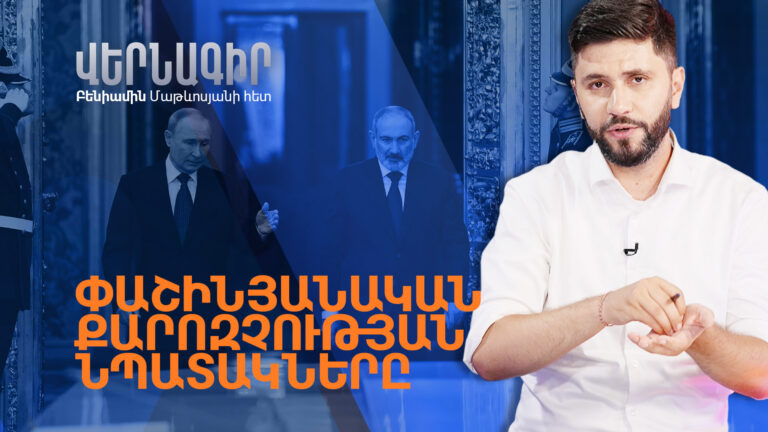

Beniamin Matevosyan: Russian sanctions against Armenia are not tied to the elections
June 17 2026, 19:00
(Pashinyan’s propaganda won’t tell you this)
Official Yerevan is increasingly trying to present Moscow’s economic pressure as a temporary pre-election factor or fleeting political jealousy that will fade on its own once domestic political cycles stabilize. The ruling Armenian authorities’ propaganda narrative aims to lull society and business into believing that the current trade barriers are merely short-term whims of the Kremlin. However, the deeper substance of what’s happening is fundamentally different from these surface-level interpretations. The restrictive measures the Russian Federation is introducing against the Armenian economy are strategic in nature and are directly tied to the fundamental shift in Yerevan’s foreign policy course, which made its choice in favor of European integration at the level of law passed by parliament.
To understand Moscow’s logic, it’s necessary to analyze how the perception of the European Union has shifted in the eyes of Russia’s military and political leadership. As clearly follows from recent tough statements by Sergey Lavrov, head of Russia’s Foreign Ministry, Moscow no longer views the EU as a purely economic or humanitarian bloc. In the Russian view, the European Union is rapidly militarizing, building security mechanisms exclusively in opposition to Russia’s interests, and effectively transforming into a hard military bloc acting in close coordination with NATO. Europe’s transformation into an overt geopolitical adversary means that any country declaring a course toward rapprochement with Brussels is automatically perceived by Moscow as a source of existential threat. This approach applies far beyond Ukraine alone, it is becoming a universal template for assessing any state in the post-Soviet space.
Consequently, the sanctions against Armenia are a direct response to the formal start of the republic’s process of joining the European family, which was marked by the adoption of corresponding legislation on beginning membership and was vividly demonstrated during the recent large-scale EU summit in Yerevan. The deepening engagement between Armenia and Brussels shifts this relationship out of the realm of sovereign multi-vector policy and into the format of a direct geopolitical challenge to Russia. The deeper Yerevan becomes drawn into the orbit of European institutions, the more it is perceived in Moscow as an open adversary deliberately dismantling the previous regional security system in the South Caucasus. Within this paradigm, Russia’s economic levers of pressure serve not as a mechanism for punishing specific politicians, but as a systemic tool for countering the expanding influence of a hostile bloc near its borders.
The scale of the threats to Armenian statehood from this kind of geopolitical pivot looks extremely alarming, as even cautious assessments from official agencies confirm. Martin Galstyan, head of Armenia’s Central Bank, acknowledged that exports of Armenian goods to Russia alone make up about 6% of the country’s GDP, and the products that came under Russian restrictions starting in May account for roughly a third of that enormous volume. In the worst case, this threatens an immediate 2% drop in the republic’s GDP, and the real long-term damage could turn out to be considerably higher, given the critical dependence of key sectors of Armenian industry and agriculture on the large Russian market. The authorities’ attempts to mask this collapse with pre-election rhetoric only underscore their unwillingness to acknowledge the price the economy and citizens will pay for a geopolitically unjustified break with traditional partners, at a time when the European market remains practically closed to Armenian goods.
Think about it…
 Now live