
Euronest turns blind eye to problems with democracy in Armenia – MEP
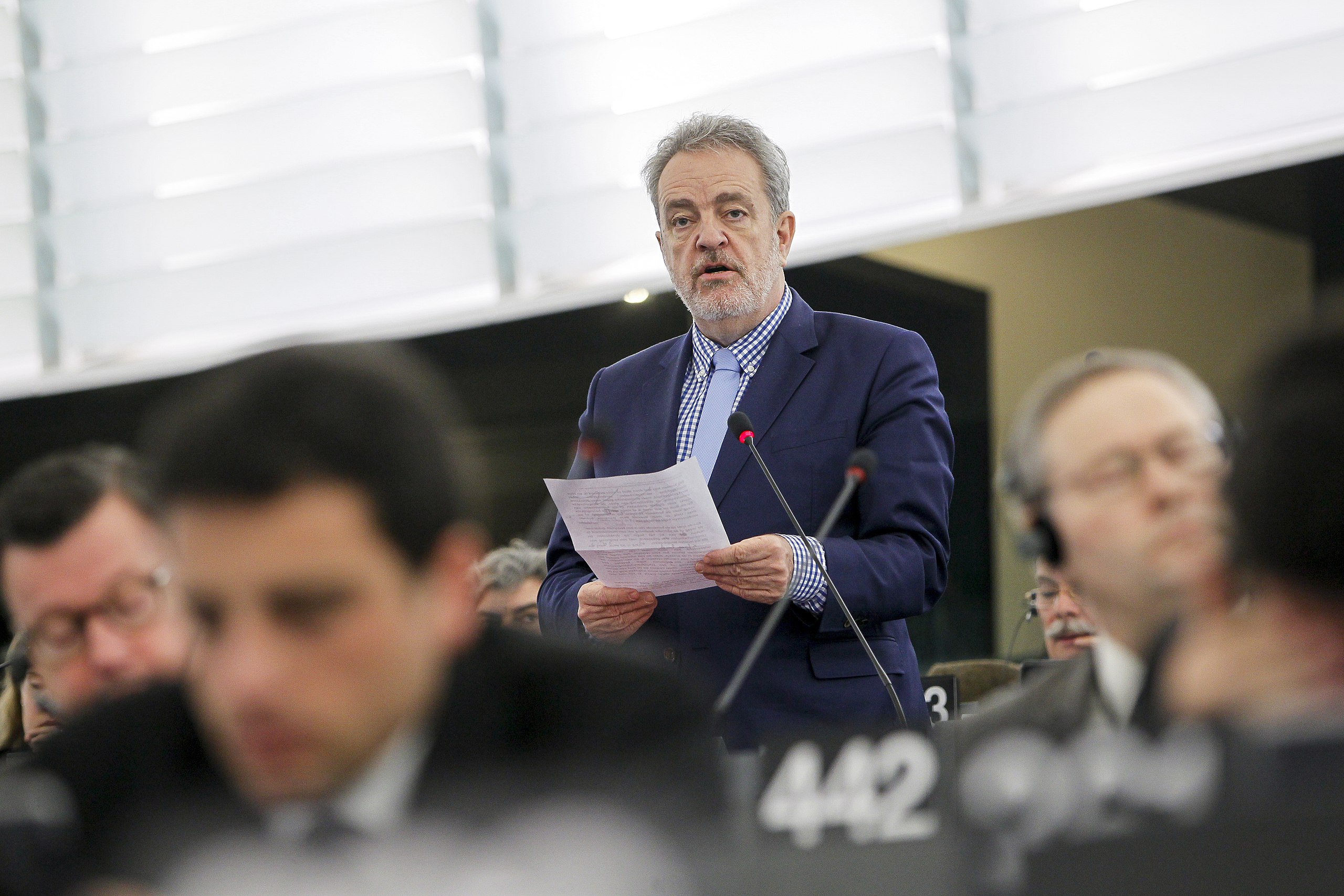
Alpha News interviewed Belgian MEP Gerolf Annemans following the Euronest session in Armenia at the end of October.
– In the context of rapprochement with the EU, how do you assess the current state of Armenia’s domestic politics? In particular, at the session in Yerevan you heard from the opposition about the existence of political prisoners, including clergymen and citizens who disagree with the government’s policies.
– I had the opportunity to conduct several interviews and conversations with both representatives of the ruling party and the opposition. My goal was to clarify the facts, since I was not deeply familiar with the details of these incidents. In discussions with members of the majority party, I heard a fairly typical line of defense: they claimed that the clergymen allegedly called for violence. Another argument was, ‘Yes, such cases exist, but the opposition forgets that they themselves were previously in power, and they were not much better. Keep that in mind,’ as an attempt to justify the situation by referring to the past. This was the second argument –and it was not much more convincing. It was not a justification for what happened, since, in their position, the justification lies in the claim of violations of the law, particularly, the principle of nonviolence and other norms. My presence there was not intended to thoroughly analyze Armenia’s internal political processes. At the same time, I cannot say that I fully share the position of the Euronest chairman or some colleagues from the European Parliament. I am not blind, nor do I close my eyes to possible problems in the functioning of Armenian democracy. On the contrary, it seems to me that some of my colleagues, in their blind eagerness to push Armenia as quickly as possible toward EU membership, tend to ignore potential difficulties. The chairman noted that we would touch on this issue, but emphasized that it was not the topic of today’s discussion. On the other hand, it was a positive sign that opposition representatives were able to show courage and speak publicly. In addition, there was also a public protest taking place in the streets, which overall is a positive signal for the functioning of democracy. As someone who has been in opposition in Belgium for 40 years, I understand well that complaints do not always bring immediate results. But if the system allows the opposition to exist – which, by the way, in Belgium we were once forbidden to do as an opposition party – this is already an important indicator. My own experience is a clear example that no democracy and no democratically functioning regime is absolutely perfect. On the contrary, I noticed that at the gates of the parliament, where we were taking official photographs, opposition representatives had also gathered. At the same time, people were shouting and making noise, creating visible activity. This gave me the impression that Armenia is moving toward the formation of an open opposition and a democratically organized majority system.
As for the facts pointed out by the opposition, I consider it unacceptable when people end up in prison for their views or for political activity. This concerns a fairly general phenomenon and does not include cases of calls for violence. Personally, I do not approve of calls for violence, but I admit that my Armenian is not good enough to fully grasp the nuances. Therefore, I did not go into the details of the accusations made by the opposition against the majority.
– How can you explain the fact that your colleagues seem to turn a blind eye to obvious problems? It almost looks like a conspiracy – as if they don’t see what is really happening. If this is about pushing Armenia toward EU membership at any cost, how do you assess the chances of success, given the unsuccessful examples so far with Ukraine and Georgia?
– To some extent, that was part of my role at these meetings. At present, the EU is in a state that I would describe as a kind of madness. We see this not only in the case of Ukraine and the issue of EU membership, but also in the applause and ovations for Zelensky, as well as the push toward NATO membership. I can understand when the chairman says: ‘We are here for cooperation and joint projects, not to discuss Armenia’s political problems.’ But in the broader context of Euronest, this appeared unbalanced. Too much was deliberately left unsaid because it interfered with the main line: ‘we must absorb them.’ The word ‘absorption’ is simply replaced with softer terms such as ‘partnership,’ ‘EU membership,’ which often conceal a very different meaning. But this is a fake, a false narrative. What happened with Ukraine is in many ways comparable to what we see here. Ukrainians trusted the West too much. I do not justify Russia’s reaction, but I am talking about something else: one must be prepared for the possibility of being deceived, with imperial plans and beautiful promises, including financial ones. But money can also come through ordinary cooperation. EU membership is not required for that. Partnership can very well be a path of development for Armenia without the need to be absorbed by the European Union.
Another extremely important issue is the rights of refugees from Nagorno-Karabakh. An amendment to the Euronest resolution on the status of refugees and their right of return – a right recognized under international law – was not adopted because it provided for international protection. As one member of the delegation told me, this happened at the request of the pro-government party, which disliked the demand to provide international security guarantees in the event of return. Yet without such guarantees, their return is simply impossible. According to this source, the ruling party insisted on removing this clause, fearing damage to relations with Azerbaijan. That was the general atmosphere: the government said, ‘We are handling everything’, and Baku will not agree to such an arrangement. I do not recall the details precisely and must check with my assistant, but I believe I voted against this. At the very least, I voted in favor of including the relevant clause in the text. Moreover, no one has the right to decide such matters on behalf of the refugees. Neither Yerevan, nor Baku, nor Pashinyan, nor Aliyev are authorized to make decisions instead of the refugees themselves. Euronest, having heard such an opinion – which was only an opinion – followed it under pressure, thereby violating the principles of international law. Of course, this is a matter of international law. Euronest missed the opportunity to take its own position on this critically important issue. The position of the Armenian government is simple: ‘Leave us alone. We are dealing directly with Baku and Aliyev, so don’t interfere.’ Euronest missed the chance to express its own view on this matter. I believe the amendment was rejected by a majority vote, although the procedures were not very formal. If the amendment had been adopted, I would likely have voted in favor of introducing this additional right. If the Armenian government cannot withstand even such a relatively harmless recommendation from Euronest, it has a serious problem. In that case, it essentially kneels before Aliyev. We are not in a situation of negotiations or dialogue; we are still in a state of war. This should have been an additional incentive for Euronest to intervene in the discussion, guided by the principles of international law. But in reality, Euronest does not carry much weight. When you try to secure even the most basic inclusion of a clause in the text, you cannot rely on it. They are on the side of diplomacy – and here diplomacy simply means the Armenian government conducting business with Aliyev.
– Do you think any document could restrain Aliyev from aggression if he chooses it? And at the same time, Euronest’s role and position took the side that violated the rights of the refugees.
– Do not overestimate Euronest: it is part of an internationally ‘politically correct’ approach. As soon as they realize that the matter concerns diplomatic relations between Armenia, the Armenian government, and Aliyev, their involvement in the issue becomes sharply limited. This can be troubling. They will not impose it. They will not promote it. And they will not vote for it. So do not rely on them – it is relatively insignificant.
– Are you saying they don’t care about these people or about international law? That they are willing to violate its principles?
– You are speaking with someone who has been in politics for 40 years. International law is the law of the leading elites, and above all of those who win wars. That is why the very concept of war does not disappear simply because of the two words ‘international law.’ In the end, international law is a matter of power. Today, power lies with the Armenian government. Power also lies with Aliyev. And it is they who, in practice, define the real boundaries of international law. So even if, in theory, the rights of these people should be determined by international law, in reality everything is decided on the ground. And the Armenian government simply does not want to go beyond the current situation. That is sad, truly sad.
– And one last question: this is just your personal opinion. Do you truly believe in the genuine peace that Aliyev and Pashinyan are negotiating today? After everything that has happened, without restoring justice, without acknowledging the crimes, and without compensation?
– First of all, I want to say that I do not wish to interfere in Armenian politics. I do not have enough information to draw definitive conclusions. But one thing I can say with certainty is that I was disappointed by the ‘flexibility’ of the current Armenian government after all these tragic events.
– What do you mean by ‘flexibility’?
– The agreements that were made with Aliyev. This flexibility was excessive. In fact, there was a retreat. Of course, the international community did not want a war over Nagorno-Karabakh. I visited the region 20 years ago; that was how I first came to know it. I traveled there, and I always had the sense that it was a powder keg, a potential flashpoint for a major war. This was long before the events in Ukraine. Weapons pointed at each other from just a few meters away…And I thought at the time: ‘I was there. I saw it with my own eyes.’ And now look at what is happening. What I see today is a retreat – not only militarily, but also diplomatically. The Armenian government is showing remarkable flexibility on issues that are, by their very nature, fundamental. But it is not for me to decide what Armenians should do. That is for Armenians themselves to decide. In Yerevan, I saw that opposition leaders have the courage and the opportunity to speak openly, even at international meetings. Please continue to do so. Because it is up to you to prove that you are better than your own government.
 Now live