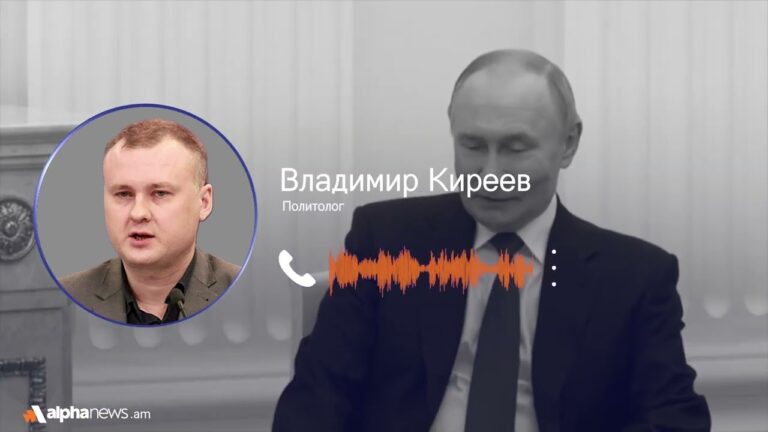

Pashinyan is going to Moscow because of risks in the Middle East: Aslan Rubaev
Aslan Rubaev, political analyst and post-Soviet affairs expert, commented to Alpha News on Armenian Prime Minister Nikol Pashinyan’s visit to Moscow.
“One way or another, Russia remains Armenia’s primary strategic partner in the areas of trade and security, and Pashinyan is not yet in a position to ignore this agenda, this reality, or this forced necessity. He has made many attempts to diversify his foreign policy, even to build his own security architecture on European standards, and has tried to orient Armenia toward NATO and the United States. But in all likelihood, Europe and the United States are not yet ready to accept and treat Armenia as a strategic partner. This is tied to the Ukrainian crisis, to the war in the Middle East, and to the fact that Armenia shares a border with Iran. So Pashinyan is trying, in whatever way he can, to shore up the relationship with Moscow that already exists,” Rubaev said.
According to the analyst, Pashinyan is doing this out of necessity, because he understands that there are currently very serious risks of destabilization in the Middle East.
“If the situation in the Middle East were to spiral out of control, Pashinyan understands that this means an enormous number of migrants, an enormous number of refugees, Armenia would be have neither the capacity to integrate them nor to stem the flow. On top of that, there is the risk of an industrial or nuclear catastrophe. So here, as always, Moscow is the one that can step in to help, and Pashinyan understands this, which is why he is heading to Moscow on a working visit. Because politics in the South Caucasus has intensified of late, driven by the Azerbaijani situation, which threatens to push the conflict to a regional level. And Armenia’s position here is weak, given that Azerbaijan is a strategic partner of Israel. If Azerbaijan were to enter the war against Iran, Armenia would find itself right at the epicenter of events, and its situation would become extremely difficult. And this is precisely where the forced need for Russia re-emerges. So I think there are additional compelled steps to be taken: an opportunity to reach some kind of agreement, to clarify Armenia’s position within the CSTO, and perhaps to negotiate more favorable terms within the EAEU. We’ll see what comes out of the visit,” Rubaev concluded.
 Now live