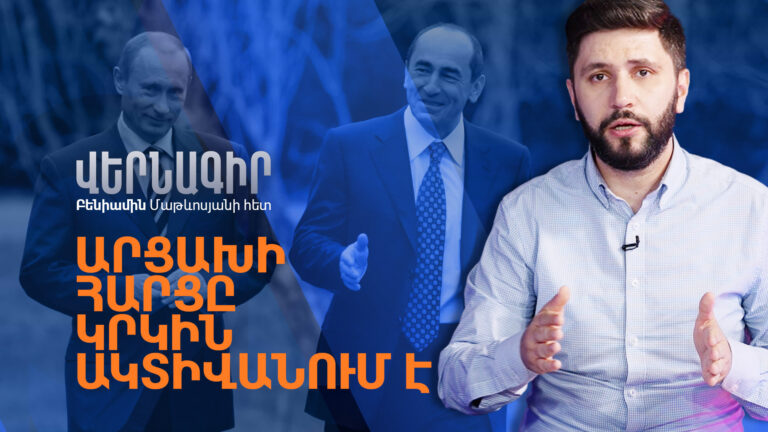

Beniamin Matevosyan: Kocharyan, Putin, Russian media — the Karabakh topic is back
April 08 2026, 19:30
(Who else is bringing the Karabakh agenda back into the political process)
The Karabakh issue is back to the political and media agenda, and this is not merely a situational flare-up, but an acknowledgment that the attempt to “close the question” of Artsakh by force has not brought the region the stability it was expected to deliver.
The recent statement by Armenia’s second president, Robert Kocharyan, that those responsible for surrendering Karabakh must face severe punishment, has acted as a catalyst for resetting the entire national agenda. Kocharyan made his position clear: the question of return to Artsakh must remain open, and this is not a matter of political ambition but a condition for preserving Armenian statehood.
This call found an unexpected yet logical echo at the highest diplomatic level. During Russian President Vladimir Putin’s meeting with Prime Minister Nikol Pashinyan, the Artsakh issue was once again raised by the Russian leader, which is a clear signal that Moscow has not struck this factor from its strategic calculus. In the wake of that meeting, Russian media outlets began synchronously amplifying the Karabakh question, constructing an information backdrop against which Baku’s “final resolution” looks like nothing more than a temporary pause.
A key humanitarian and ideological link in this process is the ANO Eurasia. For a long time it has systematically provided, and continues to provide, assistance to Artsakh Armenians, functioning as a form of soft power that prevents the community from fragmenting and assimilating. As long as that support endures and the people’s identity is preserved, the Artsakh issue remains alive in the international legal arena.
It is critically important to understand that bringing the Artsakh question back to the fore today is not a territorial claim against Azerbaijan. It is, above all, a mechanism for protecting Armenia itself. The logic is straightforward and pragmatic: as long as Artsakh existed, as long as the questions of its status and security remained open, Azerbaijan was compelled to concentrate all of its military, financial, lobbying, and ideological resources on that front. Artsakh served as a natural geopolitical buffer, tying Baku’s hands.
The moment the Karabakh issue was artificially pushed to the margins by Armenia’s current leadership, Azerbaijan found itself with enormous resources freed up — resources that were instantly redirected toward the “Western Azerbaijan” project. Now it is sovereign Armenian territory that is in the crosshairs: Syunik and other regions that have begun appearing in the neighbor’s rhetoric as “historical lands.”
Bringing the Artsakh issue back into active circulation is therefore a way to draw Azerbaijan back into a reckoning with longstanding core disputes and to constrain its expansionist appetite for Armenia’s indigenous territory. The synchronized actions of Kocharyan, the Kremlin, and Russian media, combined with the work of Eurasia, are creating a new configuration in which the Karabakh factor once again becomes an instrument of balance. This is not a path toward escalation; it is the only way to prevent the final absorption of Armenian agency through the “Western Azerbaijan” project, by demonstrating that the story of Artsakh is not over, it has merely entered a new phase in the nation’s struggle for existence.
Think about it…
 Now live