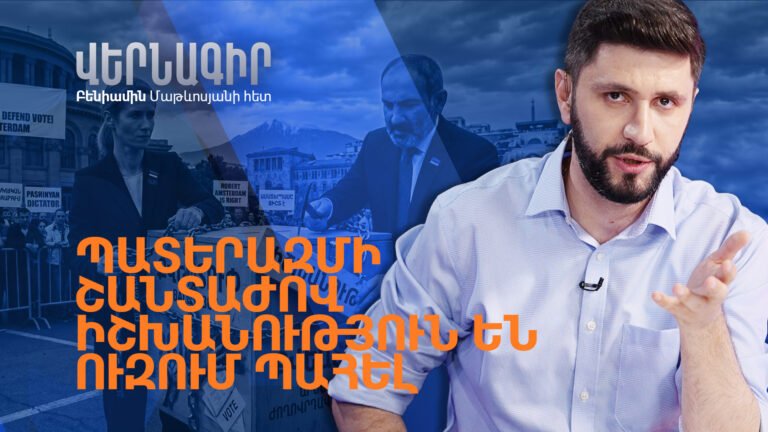

Beniamin Matevosyan: Protecting Armenian democracy from Pashinyan and the EU
March 31 2026, 19:00
(By threatening war and inviting foreign interference, Pashinyan seeks to hold onto power)
Setting aside the processes unfolding in the corridors of power, the people who took to the streets in 2018 did so not to swap one face for another, but to address their socioeconomic grievances and reclaim a voice that could no longer be heard through blocked democratic institutions. No matter how a citizen voted, the Republican Party of Armenia always came out on top when the ballots were counted. Nearly eight years have passed, and today we are witnessing a pattern that is classic in world history: those who rose to power on the tide of the struggle for democracy and fair elections are now themselves trying to hollow out the very essence of popular will.
Yerevan’s current political course increasingly resembles a dangerous replica of the “Moldovan scenario.” In Moldova, opposition parties were barred from elections and their voices were drowned out, all to the applause of European officials. Today, the same scenario is playing out in Armenia. We are seeing massive attacks on opposition media outlets, the use of bot armies to block the pages of political opponents on social media platforms including TikTok and Facebook. The pressure on Samvel Karapetyan’s party, or the blocking of Narek Karapetyan’s accounts, are hardly accidental technical glitches, they look like a coordinated operation requiring enormous resources.
The European Union plays a particular role in this game. Rather than acting as an impartial arbiter, Brussels has effectively taken the side of the incumbent authorities. The allocation of 12 million euros to combat so-called “hybrid threats,” and the dispatch of “rapid response teams” at Nikol Pashinyan’s request, look like direct funding for an information-space purge. Under the pretext of countering foreign influence, Armenia’s authorities are being handed a blank check to suppress any domestic dissent.
International lawyer Robert Amsterdam has already openly called on the European Union to stop taking sides in the country’s internal affairs. His position is clear: if the EU wishes to preserve its credibility as a defender of democracy, it must not become a tool in the hands of a single politician. When international support is turned into a lever for staying in power, trust in democratic values is undermined for decades to come.
Nikol Pashinyan’s current strategy is built on exploiting the fear of a new war. The authorities, who have presided over three wars in eight years, are methodically frightening citizens with threats from Azerbaijan and Turkey, instilling in the public the belief that any political change will lead to national catastrophe, while never telling their own people that a country where power rests on fear and foreign handouts cannot be strong.
In order to preserve the EU’s neutrality, the opposition could well propose that Brussels reconsider the format of its engagement with Armenian actors (both the authorities and the opposition forces) so as to avoid the appearance of a biased player. Key proposals could include the establishment of a monitoring body to assess the electoral environment, the equality of candidates’ rights, and the level of judicial independence prior to the start of voting. The EU Rapid Response Group deployed to Armenia must engage not only with the authorities, but also with alternative civic and religious institutions. The group’s work should be directed against manipulation, not against legitimate political criticism.
In 2018, people came out into the streets to resolve their socioeconomic problems, and also because they had no other institutional means of defending their rights, the institutions of democratic power transfer through elections had been destroyed. Today, the authorities are likewise fighting against those same institutions and practices either by frightening Armenian citizens with the prospect of war, or by drawing in the EU for electoral support. If the authorities dare to steal the people’s choice, they should know they will get a revolution, but this time, a real one. Citizens and political forces must be prepared to defend Armenian democracy from Pashinyan, from the EU, and from Turkey and Azerbaijan alike.
Think about it…
 Now live