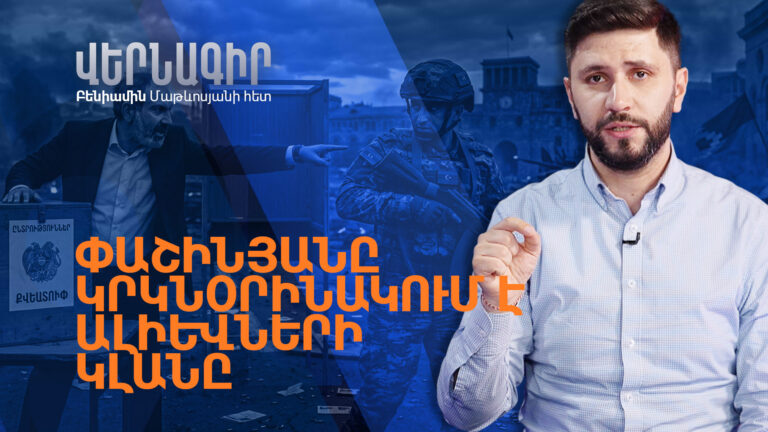

Beniamin Matevosyan: “Vote for Civil Contract or die” — Pashinyan blackmails the nation
March 25 2026, 19:00
(Pashinyan takes a page from the Aliyev clan and sets his sights on lifelong rule)
Prime Minister Nikol Pashinyan’s statements about the inevitability of war in the event of a change of power open a new and deeply troubling chapter in Armenia’s political life. What is unfolding before us is a textbook transformation: a leader who rose to power on a wave of democratic slogans is now presenting his continued rule as the sole guarantee of the nation’s physical survival. By claiming that any attempt to revise his “peace agenda” will lead to catastrophe as early as this autumn, the Prime Minister is effectively equating his own political longevity with state sovereignty. Pashinyan is issuing a blackmail: vote for Civil Contract or die.
This approach bears a suspicious resemblance to the authoritarian model of governance characteristic of neighboring Azerbaijan. Pashinyan appears to be adopting the strategy of the Aliyev clan, where the legitimacy of power rests not on economic prosperity or civil liberties, but on the status of an irreplaceable guarantor of security. Within this framework, elections cease to be a tool of development and become an act of surrender to fear: the people are called upon to vote not for a vision of the future, but against the horrors of the present. In doing so, the Prime Minister is openly pursuing lifelong rule, using an existential threat, one largely of his own making, as the perpetual engine of his political survival. Yet this logic contains a fatal admission that nullifies years of government rhetoric. If regional peace rests solely on the fragile thread of Pashinyan’s personal loyalty to the current pro-Azerbaijani course, then the entire propaganda construct of “international guarantees” proves to be a colossus with feet of clay. For years, society was persistently told that Armenia’s security now rests on new frameworks: from symbolic expectations tied to US President Donald Trump’s signature, to agreements under TRIPP and Brussels platforms. Now the very architect of this strategy admits: no security architecture exists. All that exists is a fragile personal arrangement that will “crumble to dust the moment the name on the door of the Republic Square office changes.”
This means that the “peace agenda” in its current form has been a lie fed systematically to the public. Instead of real guarantees and a strengthening of defense capability, the country was offered a psychological dependence on a single individual.
If any political discussion or democratic rotation of power automatically leads to war, then Armenia is not in the process of establishing peace — it is in a state of indefinite hostage-taking. Such statements by the Prime Minister devalue the very concept of democracy, turning it into a dangerous luxury the country supposedly cannot afford. What we are left with is a troubling paradox: for the sake of a phantom “peace” that can be shattered at any moment at a neighbor’s whim, citizens are asked to surrender their right to choose — embracing a model of power they once took to the streets to oppose.
Think about that…
 Now live