
Putin-Trump meeting is great success of Russian foreign policy – Georgi Asatryan
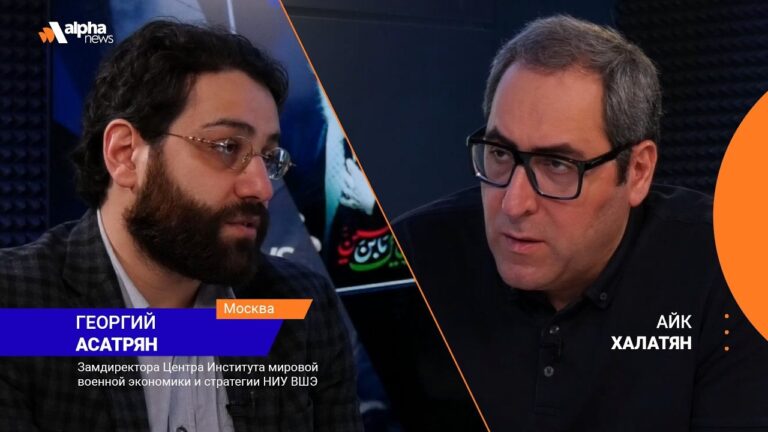
Speaking with Alpha News, Georgi Asatryan, Deputy Director of the Institute of World Military Economy and Strategy at the National Research University Higher School of Economics, commented on the meeting between Russian President Vladimir Putin and US President Donald Trump in Alaska, the results of the meeting between the Prime Minister of Armenia and the President of Azerbaijan, mediated by Donald Trump, as well as Iran’s position on this issue.
“I have very positive impressions of the meeting. It had been in preparation for a long time, and it was clear that the agreements reached had likely been finalized beforehand. This is always the case in international bureaucracy, such leaders would not meet without fairly serious agreements. Therefore, I believe that there are some agreements, we will probably learn about them later, but the meeting is very positive, very serious. The American side demonstrated a very serious ceremony at the meeting of the Russian leader. All this suggests that the leaders of Russia and the United States have a certain level of mutual understanding, respect for each other. There is a fairly serious dialogue at different levels, with the involvement of experts, departments, diplomats. Relations between Russia and the US, which had deteriorated under the previous Democratic administration led by Biden, are now undergoing normalization. The main topic, of course, was Ukraine. And here, I think, there is also a certain rapprochement between the parties. While nothing monumental has occurred yet, progress is evident. A year ago we seriously discussed the possibility of a nuclear catastrophe. Now the attitude is completely different, international processes are developing completely differently. Trump’s position aligns more closely with Russia than with Ukraine, and that’s quite apparent,” Asatryan emphasized.
According to the political scientist, European powers may attempt to undermine the developments in Alaska.
“Both the globalists in Europe and the European leaders will seek to sabotage the processes that took place in Alaska, they will actively engage in this. It is difficult to judge whether they will succeed or not, the Europeans want the conflict to continue, in this case they are the party that negatively influences international affairs and the situation in Eastern Europe,” Asatryan noted.
At the same time, the expert added that judging by the policies of the authorities of EU countries, they are preparing for a military conflict with Russia.
“Europeans are preparing for war with Russia. I think that wars will be quite common in international relations in the coming decades. Unfortunately, this is a possible scenario. I don’t know when, how, or how inevitable it is, but I believe it is a very possible scenario,” Asatryan noted.
According to the expert, the meeting between Pashinyan, Trump and Aliyev in Washington was superficial.
“Trump really wants to win the Nobel Prize and reconcile completely different parties. In my opinion, nothing special happened at this meeting. Some kind of memorandum was signed. This is, of course, not a peace agreement, it does not change the balance of power, it does not bring us closer to any serious and positive consequences. I see it as an attempt by both South Caucasus republics to curry favor with Trump. In some ways, that’s understandable; in others, less so. But overall, it was symbolic rather than substantive—a dummy,” Asatryan said.
Touching upon Iran’s allegedly dual position on the agreements in Washington, the expert noted that Iran’s official opinion is sharply negative.
“Iran views the presence of extra-regional forces in the South Caucasus and along its northern borders as a serious threat to international security. It’s just that diplomats, the president and the reformist wing in general are trying to resolve issues in a more diplomatic, softer way and are trying not to irritate Trump unnecessarily.
This is, of course, a threat to Iran’s national security. Therefore, I believe that at least at the diplomatic level they will seek to counter this development,” Asatryan concluded.
 Now live