
China has an extremely negative attitude toward the ideology of pan-Turkism: Vasily Kashin
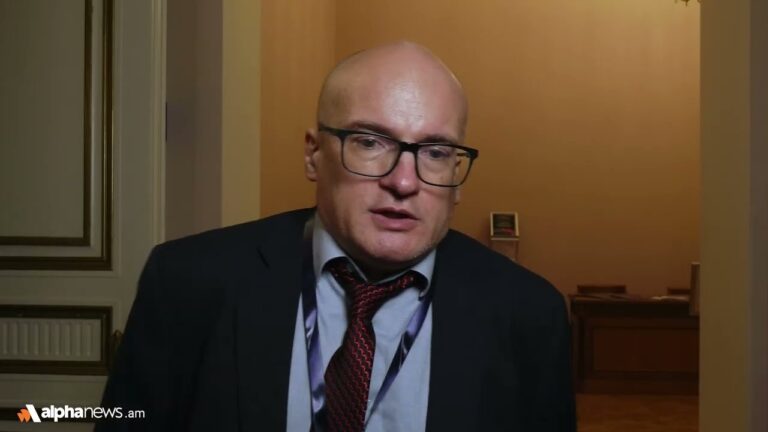
Vasily Kashin, director of the Center for Comprehensive European and International Studies (CCEIS) at HSE University, spoke to Alpha News on the sidelines of the international academic conference “Russia and the new multipolarity: from idea to reality,” held to mark the CCEIS’s 20th anniversary. He commented on China’s policy in the South Caucasus, Russia’s attitude toward Beijing’s activity in the post-Soviet space, and relations between China and Turkey.
Asked about China concluding strategic partnership agreements with all the South Caucasus republics, Kashin stressed that there are no contradictions with Russia in the region.
“Russia’s position in the South Caucasus is changing significantly right now because of factors unrelated to China. I think Chinese activity is not the main thing that worries Russia, although we see great progress in China’s relations with Azerbaijan and, traditionally, with Georgia.
Georgia is the oldest partner, and it set the general direction for the other countries of the region in cooperation with China: there is interest in the region’s infrastructure and transit potential, and corresponding projects are being implemented in Georgia. A powerful breakthrough was achieved in the South Caucasus arms market with the delivery of 24 FC-1 fighter jets to Azerbaijan (formally Pakistani, but with a predominant share of Chinese intellectual property; the Pakistani JF-17 – editor’s note). China’s role is growing. It is clear that Azerbaijan is trying very actively to strengthen its partnership with China. This is a big bet, although it is unclear how far it can go.
Armenia is probably moving in this direction to the least extent, although there is some interest too (this is linked to its European aspirations). In addition, Armenia has developed a military-technical partnership with India, which also does not add to China’s trust, although Armenia was once the first post-Soviet country to buy Chinese weapons, a large batch of multiple rocket launchers in 1999. But now its China vector is the least pronounced, and there may of course be limitations linked to the TRACECA route and the ‘Trump corridor’: for the Chinese, a corridor in which the US plays the predominant role may be somewhat problematic,” the political scientist said.
According to Kashin, although economic relations between China and Turkey are developing actively, China is wary of Turkey’s pan-Turkic aspirations.
“With Turkey, we see great economic interest, but there are also political contradictions. Relations with Turkey are characterized by growing volumes of economic cooperation and interest in transit potential, but a low level of trust. The Chinese have an extremely negative attitude toward the ideology of pan-Turkism, and toward any manifestations of political Islam, which the modern Turkish state is partly associated with.
But there is interest in pragmatic cooperation. Turkey uses its ties with China to balance its dependence on the West, while China conducts its own political work with Turkey. This is a developing relationship, but one with very clear constraints and its own ceiling,” the expert concluded.
 Now live