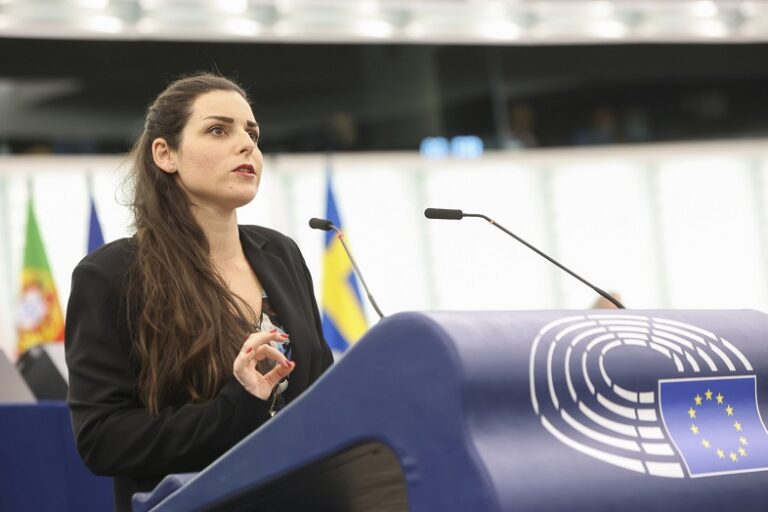

EU Must Defend the Rights of the People of Artsakh Regardless of the Armenian Government’s Position — MEP
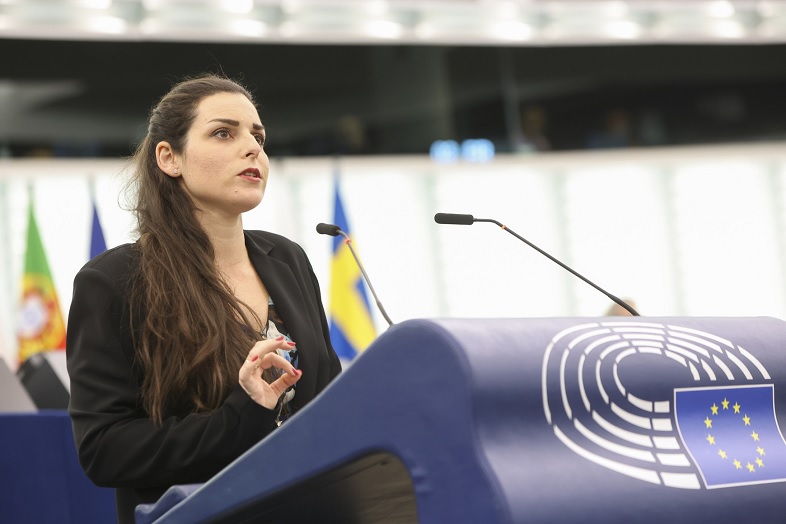
French MEP Marina Mesure spoke to Alpha News about the issue in an interview she gave to Alpha News.
Question: You secured the inclusion of a provision calling for the immediate and unconditional release of Armenian political prisoners held in Baku in the European Parliament’s resolution on political prisoners in Azerbaijan, adopted on October 8. This is a significant achievement, as even some of Baku’s most outspoken critics had previously been reluctant to raise the issue. Azerbaijan had sought to portray such criticism as driven by “Armenian influence” and as an attempt to exert pressure on the country. This narrative allowed criticism to be dismissed as the actions of a hostile party rather than treated as an objective discussion of the situation of political prisoners, regardless of their ethnic background or political status.
Answer: The issue of Armenian political prisoners was my main demand. I know that I am sometimes told that such issues fall outside the scope of the discussion and therefore cannot be raised. I had previously tried to raise the issue of Armenian prisoners when we were discussing the case of an academic who had been subjected to repression in Azerbaijan. At the time, I was told that it was not possible because the issue fell outside the scope of the discussion.
This time, I approached the matter on the basis that we were discussing political prisoners and, consequently, the politically motivated persecution of Armenians. Ultimately, the issue was included in the document. This is significant because it marks the first time we have succeeded in securing the inclusion of such a provision.
When I put forward this proposal in the political groups, I encountered no opposition. I literally said just three words: “We must mention the Armenians,” and the representative of the European People’s Party immediately agreed.
The second issue I sought to include during negotiations with the political groups concerned visits to Baku by Ursula von der Leyen and the EU Special Representative, Magdalena Grono. I also sought to strengthen the wording stipulating that any future EU-Azerbaijan partnership agreement should be conditional on tangible improvements in the country’s human rights situation.
Specifically, I proposed expressing regret that, during a recent visit to Azerbaijan by a senior EU representative, no call was made for the release of Armenian political prisoners. I considered this an important point, but we were unable to secure its inclusion. Nevertheless, it remained one of my key demands for the resolution.
What matters most to me now is to say: thank you for this resolution, but the time has come not to adopt new documents, but to take action.
There is a French expression for this: l’art de se donner bonne conscience — the art of assuaging one’s conscience. At times, it seems that new resolutions are adopted simply so that we can say we have passed yet another document on the situation in Azerbaijan.
Meanwhile, EU officials travel to Baku to discuss a new partnership agreement, and an EU representative visits Nagorno-Karabakh. This reveals a disconnect between what we say in the European Parliament and enshrine in our resolutions, and how we conduct our relations in practice.
Question: In your view, what are the consequences of this inconsistency in EU policy?
Answer: I recently spoke at the UN headquarters and received a response to my question that reaffirmed the international right of Armenians to return. Whereas the EU had previously explicitly referred to this right in the context of Nagorno-Karabakh, however since 2023 it has effectively stopped reiterating this position publicly. That is why it was important for me to secure a clear answer in Geneva. Even if phrased in diplomatic terms, an explicit reference to the right of return is of fundamental importance.
This is particularly important now, as the EU strengthens its relations with Baku. In recent months, Ursula von der Leyen and Roberta Metsola have visited Baku, and an international delegation paid an official visit in September. In August, the International Court of Justice once again considered the issue of Armenian prisoners held in Baku.
The European Commission, however, has made virtually no public statements in response to Ilham Aliyev’s latest harsh remarks against Armenia. At a recent summit, Aliyev made an outrageous statement suggesting that he could advance as far as Yerevan.
Question: He (Ilham Aliev) has repeatedly referred to Armenia as “Western Azerbaijan” and questioned its existence as a state. Does this not indicate that he lays claim to the entire territory of Armenia? Does the silence surrounding these developments not create the impression that Baku can act with impunity, thereby encouraging Aliyev to take further action?
Answer: What concerns me most is that the EU is now expressing its readiness to strengthen relations with Azerbaijan, citing the peace agreement currently under negotiation. Aliyev’s statements are not new, but in the current context, they take on particular significance in light of everything that has happened and against the backdrop of the visit by an EU representative to Nagorno-Karabakh. The result is that the EU is strengthening its ties with Aliyev even though his stance toward Armenia has not changed.
That is precisely why it is particularly important to keep raising this issue. Furthermore, this summer, the EU called for the release of political prisoners and the preservation of cultural heritage, but made no mention of the right to return. This is a fundamental right that cannot simply be dismissed as a consequence of war. People have the right to return to Nagorno-Karabakh.
This right has also been recognised at the United Nations level. Armenia’s Human Rights Defender, whom I met in July, told me the same: even if the Armenian government is not currently placing as much emphasis on this issue, the Human Rights Defender’s Office considers it essential to continue defending the right to return.
That is why we continue to press the EU to adopt a clear position. My next concern is the visit to Nagorno-Karabakh paid by Magdalena Grono, the EU Special Representative for the South Caucasus and the crisis in Georgia. I submitted four or five questions to the European Commission and received answers to virtually all of them, with one exception. I have yet to receive a response from the Commission regarding Grono’s visit to Nagorno-Karabakh.
Another important admission came in the Commission’s latest response: the EU explicitly acknowledges that it needs to cooperate with Baku because of its gas needs. This raises a contradiction: why does the EU criticise dependence on Russian gas if some of the gas transiting through Azerbaijan is of Russian origin? We know it. There are clearly a number of inconsistencies in this policy.
That is why it is important to continue raising this issue in the context of the EU’s energy partnership with Azerbaijan, particularly now, as Baku issues new threats. The EU must take these threats into account and respond accordingly.
I understand that, given its geography and the circumstances it faces, the Armenian government may find it more difficult to adopt a firm position. However, the international community cannot abandon international law or its own stated commitments. The issues at stake are the right of return, the immediate release of political prisoners, and the protection of cultural heritage.
The European Union is part of the international community. The position taken by the Armenian government must not absolve the EU of its responsibility to uphold these principles.
For me, it is important to focus specifically on the position of the international community. It has a duty to uphold international law, and that is precisely why we must continue to press for its enforcement. Otherwise, we risk setting a dangerous precedent that anything is permissible and that it is possible to move on to the next step without consequences. This is all the more dangerous when we are talking about long-term peace.
I am not taking a position on the decisions of the Armenian government; that is not my role. I am speaking from the standpoint of the international community and the need to uphold international law.
Question: But can there really be a peace agreement without accountability for what has happened? If there is no justice, what kind of peace can we speak of?
Answer: I am convinced that justice is essential to lasting peace. A peace agreement can certainly be reached, but if we want that peace to endure, accountability and justice must be part of the process.
At the same time, I cannot speak on behalf of Armenia or dictate what a peace agreement should look like. That is for the Armenian side to decide. I want a peace in which Armenians feel safe, and that is precisely why I believe lasting peace is impossible without justice.
It is not for me to decide what such an agreement should include. If, for example, Ukraine were to sign an agreement with Russia tomorrow, it would not be my place to determine its terms. That is for the people concerned and their country to decide. I may have my own views, but it is not my place to impose them.
Question: You visited Armenia this summer. What impressions did you take away from your trip and your meetings with refugees? Was there anything that particularly moved or surprised you?
Answer: The meetings were deeply emotional, especially those with children. Children speak more freely and openly, share their thoughts directly, and ask very specific questions.
Before my visit, I viewed the right to return primarily as a political demand raised at the international level. But in Armenia, I came to understand just how deeply this desire is felt by the people themselves. They told me plainly that they wanted to return and that the international community must continue to press for this right to be realised.
As I mentioned earlier, everyone was talking about political prisoners and cultural heritage, but almost no one was talking about the right to return. That is precisely why I decided to raise the issue. When I travelled to Armenia and met with refugees from Nagorno-Karabakh, I realised just how important it was to them.
When the children were asked what they dreamed of, their answer was: “To return to Artsakh.” They did not say they wanted to become professional footballers or pursue some other ambition. They spoke specifically about returning to Artsakh. They shared their dreams and talked about what they wanted to do in life, but they also asked me to keep speaking about Artsakh. It mattered to them that we did not forget. Their message was clear and powerful.
I could see that the children, too, had been traumatised by what had happened. Three years have passed, yet they are still struggling with the experience. Their message was simple: “Do not forget us.”
At the same time, they now have lives in Yerevan, with friends and familiar surroundings. Yet their connection to Artsakh remains incredibly strong. That is what I felt during our meeting, and it is why it became one of the most important encounters for me.
My meeting with Mr Beglaryan, a representative of the Artsakh leadership, was also extremely important to me. He spoke in detail about the events of 2020 and 2023, the devastating period of the blockade, and what people went through when they were forced to leave everything behind, including their homes and personal belongings.
Hearing people recount these experiences firsthand is entirely different from simply reading about them in a newspaper. They also continue to share accounts of what is happening now. For example, they showed me social media posts in which Azerbaijani servicemen enter people’s homes and film what has been left behind.
The people of Artsakh cannot return to their homes and do not know what has happened to their property, yet they sometimes come across footage of it on social media. For me, this was one of the most powerful moments of our meeting.
Question: To conclude our interview, I wish to ask you about the trade unions. I know that the trade union movement is particularly important to your political work. What did you learn about the unions during your meetings in Armenia?
Answer: This meeting was particularly important to me because I have been involved in the trade union movement since the very beginning of my career. This is about more than geopolitics and human rights; it is also about the direction in which Armenia is developing — labour rights, social dialogue, working conditions in Yerevan, and the creation of a well-functioning labour market that genuinely serves people’s interests.
The trade union movement in Armenia is only beginning to develop. Previously, trade unions were virtually non-existent, so something new is now taking shape. Many young people and women are involved in this movement, including in leadership positions. I find it important that they are working to lay the foundations for social justice and social progress. I remain in contact with them and want to understand what opportunities closer cooperation between the EU and Armenia could offer.
Even if Armenia does not formally apply for EU membership, closer relations can already help the country draw on European social and environmental standards and work towards their implementation. This is precisely what we are discussing with the trade unions: how European standards can be used and how to encourage the Armenian government to put them into practice, including in agriculture and other sectors.
For me, it is important not to focus on just one area of work, however significant it may be. If we want to be consistent, we must also discuss what Armenia itself can do to advance its development.
 Now live