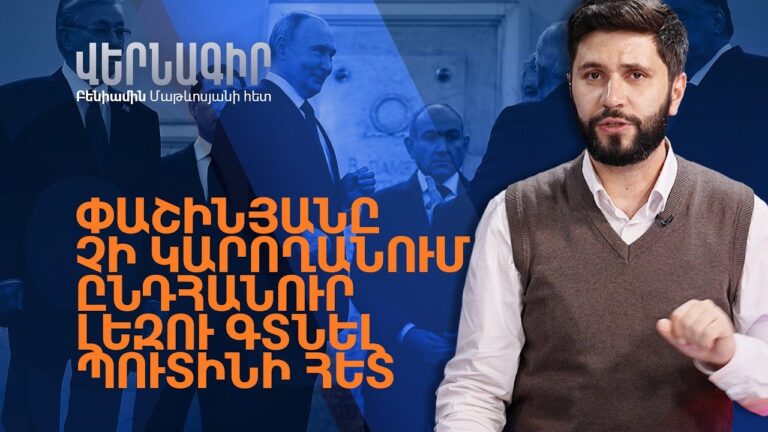

Beniamin Matevosyan: Pashinyan just can’t find common ground with Putin
November 06 2026, 12:00
(The pre-election lie about dialogue with Moscow continues)
A series of public statements by Armenia’s leaders shows clearly that the country’s current government has reached a dead end in its relations with Moscow. Today’s statements by Nikol Pashinyan, Prime Minister; Ararat Mirzoyan, Foreign Minister; and Gevorg Papoyan, Minister of Economy, show that Yerevan is completely unable to build a constructive and pragmatic dialogue with the Russian leadership.
Pre-election promises and rhetoric that all disagreements would start being resolved quickly after June 8 turned out to be nothing more than a ploy to win over voters. The authorities no longer talk about breakthroughs. They only modestly express hope that restrictions on exports to Russia will soon be lifted, while blaming external circumstances and their predecessors for their own diplomatic failures.
With each passing day, it is becoming harder for Armenia’s Prime Minister to fend off reasonable questions about the country’s inevitable expulsion from the EAEU. Pashinyan’s attempts to smooth things over look highly unconvincing when, amid close economic cooperation with Russia (Moscow remains the main investor in the Armenian economy and its main trading partner), he starts talking about plans to apply for European Union membership in 2027 or 2028. Yet these reflections on a European path are purely speculative. Whether Yerevan will submit an application within that timeframe is an open question, and the prospect of Brussels approving it looks even more doubtful. Submitting such an application in no way guarantees real integration, but it could well provoke a final break with current allies and partners.
Pashinyan’s statements that the country has no alternative to the EAEU for now but is actively working to create one only highlight how chaotic the current course is. In an attempt to “have it both ways” (or, more precisely, to keep receiving money from Russia while integrating the country into an alliance hostile to Moscow), the Prime Minister says he intends to give the people the right to choose, while stressing that no direct preparations to leave the EAEU are under way. At the same time, Pashinyan has effectively written off military and political cooperation with Russia, openly stating that Yerevan’s interest in the CSTO is completely exhausted.
Such rhetoric inevitably raises questions, and sometimes outright irritation. Maria Zakharova, the Russian Foreign Ministry spokesperson, has said so directly, pointing to verbal gymnastics and attempts to mislead the people of Armenia.
The Armenian government’s economic team is trying to give this political line a theoretical basis, but the arguments of Gevorg Papoyan, the Minister of Economy, look more like an attempt to justify future losses. His talk of the “shameful terms of Armenia’s accession to the EAEU” a decade ago (who would know the accession terms better than Papoyan, a former member of the Republican Party of Armenia (RPA)?) and his complaints about the unfair distribution of revenue among union members seem odd, given that the EAEU has provided the Armenian economy with enormous preferences and growth in recent years.
“We should have derived even greater benefit from the EAEU, but that didn’t happen. Armenia should not be giving 450 and getting 250; it would be fair for Armenia to receive 900 while giving 450. Armenia joined the EAEU on shameful terms,” Papoyan said, referring to what he considers an unfair formula for redistributing customs duties among member states.
Papoyan is in effect claiming that when Armenia joined the union in 2015, its negotiators agreed to a fixed redistribution percentage that was too low. By his logic, Armenia’s trade and import volumes have grown, the country pays far more in duties into the common EAEU budget than it gets back, and with payments at this level, Armenia’s fair share should be several times higher. However, complaining that the country gives more than it receives, and trying to postpone discussion of trade barriers with Russia on the pretext of not being ready, only proves that Yerevan has no clear economic strategy.
This foreign policy will lead to an extremely difficult scenario for Armenia. Everything suggests that by 2027 the country will effectively cease to be a full member of the EAEU and will lose key economic preferences, discounted energy prices and its traditional market in Russia. At the same time, Yerevan will not get a real alternative in the West and will end up in economic isolation. Pashinyan’s inability to find common ground with Putin, and his tendency to be guided by personal political ambitions and views, once again put Armenia’s national interests and the well-being of its citizens at risk.
Think about it…
 Now live