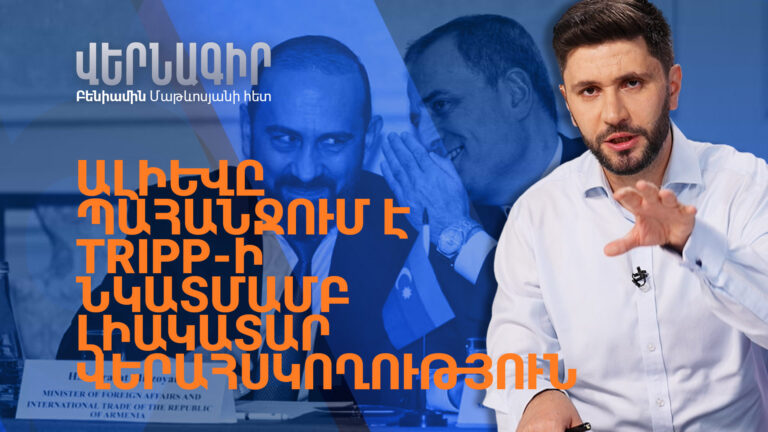

Beniamin Matevosyan: Aliyev demands total control over TRIPP
November 19 2026, 12:00
(Another myth of Pashinyan’s propaganda shattered)
The statement by Jeyhun Bayramov, Foreign Minister of Azerbaijan, at a joint briefing with Johann Wadephul, Foreign Minister of Germany, has finally made the situation around the so-called “Trump Route” (TRIPP) clear. Baku openly insists that the technical parameters of the transit artery, which runs through the sovereign territory of the Republic of Armenia, must be agreed with the Azerbaijani side.
Bayramov’s argument is both extremely pragmatic and cynical: since the route’s entry and exit points lie on Azerbaijan’s borders, the project makes no sense at all without a connection to Azerbaijani infrastructure. Official Baku is thus publicly stating a simple truth: despite its high-profile American label, TRIPP is a project being implemented primarily for Azerbaijani purposes, in Azerbaijan’s interests and to Azerbaijan’s blueprint.
In recent months, official Yerevan has built an elaborate propaganda construct around the agreement with Washington. After the framework document was initialed during the May visit of Marco Rubio, US Secretary of State, and then signed in June, Armenian citizens were persistently told that it was a diplomatic triumph. It was claimed that granting a US management company exclusive rights to develop the Syunik transit route for 99 years, with a 74/26 split of shares in the first stage, would guarantee the preservation of Armenian sovereignty and jurisdiction. Moreover, the project was presented as a way to remove Baku from negotiations on the road’s status, leaving Armenia one-on-one with Washington.
However, the news that a joint trilateral technical working group has been operating since November 6 at the initiative of the United States itself completely invalidates this claim. Washington did not isolate Baku from decision-making on Armenian territory; on the contrary, it institutionalized Baku’s participation in designing communications within Syunik.
The key political paradox of the situation is the complete asymmetry of the benefits. Azerbaijan’s main strategic goal, uninterrupted land access to Nakhchivan through Armenian territory, becomes the central axis of the entire construct. Meanwhile, Yerevan receives in return neither a signed peace treaty, nor real security guarantees, nor even a symmetrical unblocking of its own communications. While Baku dictates the technical standards of someone else’s infrastructure, Armenia itself is still unable to use its own territory and adjacent highways for direct, full-fledged rail links with Russia and Iran.
The attempt to bypass established regional realities is running into objective infrastructural and legal barriers, which Moscow has pointed out directly. These include technical compatibility with Russian-standard railway gauge, the presence of Russian border guards on the Armenian-Iranian border, and the concession agreement with South Caucasus Railway, which is in force until 2038.
In the end, the high-profile geopolitical brand “Trump Route for International Peace and Prosperity” means that Armenia loses control over a key transport hub to a foreign corporation, while Azerbaijan secures a veto over the project’s technical parameters. The rhetoric about the “Crossroads of Peace” and unshakable Armenian jurisdiction is shattered by harsh reality: Baku views the Syunik section solely as a transit appendage to its own transport network, seeking what are essentially extraterritorial conditions without any reciprocal political or economic concessions to Yerevan.
Think about it…
 Now live