

Tectonic shifts on Capitol Hill: how the 2026 elections strengthened the pro-Armenian bloc in the US Congress
November 05 2026, 11:10
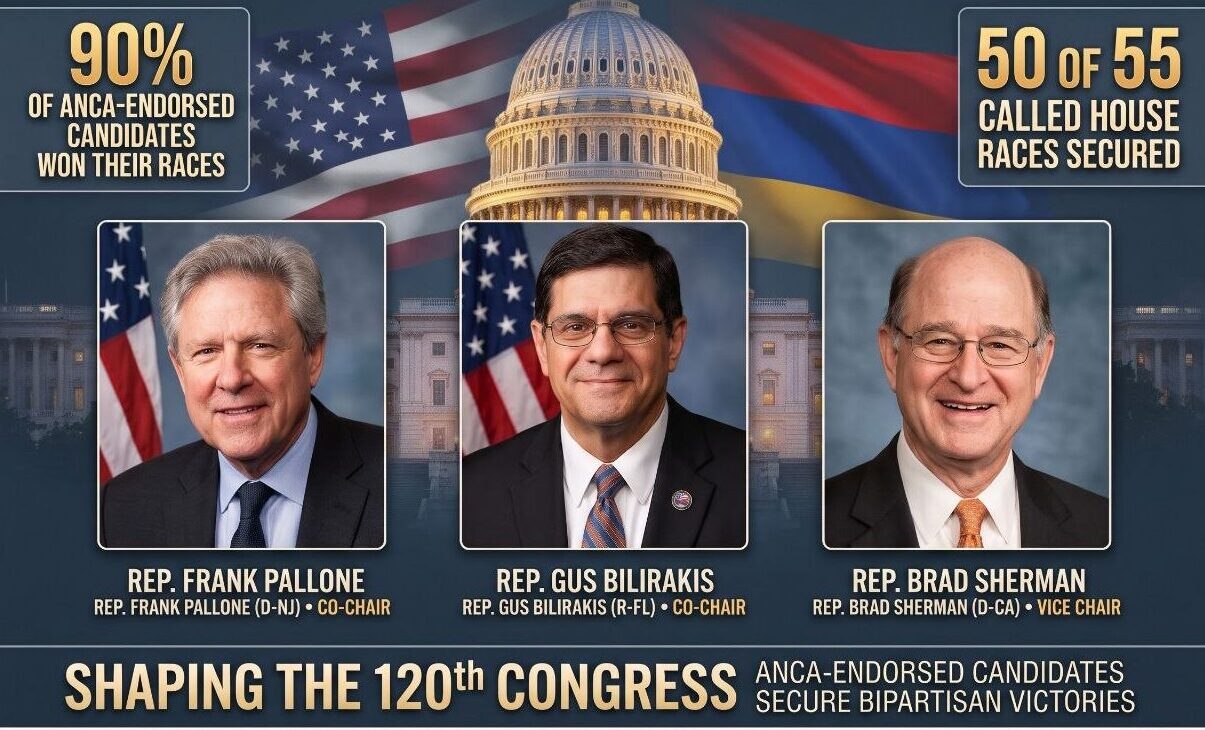
The 2026 US midterm congressional elections ended in a resounding victory for candidates who support the Armenian agenda. According to a report by the Armenian National Committee of America (ANCA), ANCA-endorsed candidates won 50 of the 55 House races called so far. In the Senate, the success was complete: all seven endorsed candidates won in their states. A powerful bipartisan pro-Armenian bloc is taking shape in the 120th Congress, ready to champion the interests of Yerevan and Artsakh at the highest legislative level.
Core of the Armenian caucus: proven leaders hold their ground
Key figures in the Congressional Caucus on Armenian Issues not only won reelection but also kept their top “A+” ratings from ANCA. Frank Pallone (D-NJ), the caucus’s longtime co-chair, who has defended the interests of the Armenian community for decades and has visited Nagorno-Karabakh several times, will continue to lead the group. Joining him in the caucus leadership are Gus Bilirakis (R-FL), co-chair, and Brad Sherman (D-CA), vice chair.
In the last Congress, Pallone and Bilirakis co-authored landmark initiatives, including legislation to review sanctions against Azerbaijan (together with Dina Titus) and joint calls for strict enforcement of Section 907 of the Freedom Support Act, which restricts military aid to Baku. Brad Sherman, for his part, has spent 30 years advancing funding for Armenia, the protection of Christian cultural heritage in the region and the expansion of Armenian Genocide education programs (including bill H.R.2585).
Other key allies with top ratings also returned to the House: Democrats Jim Costa, Judy Chu, Laura Friedman and Gabe Amo, as well as prominent Republicans Chris Smith, Nicole Malliotakis and Vince Fong.
Purge in the opposing ranks: defeats for the “pro-Azerbaijani” lobby
The 2026 elections dealt significant losses to politicians who had taken anti-Armenian positions. About 30% of House and Senate members who received ANCA’s lowest grades, “D-” and “F,” will not return to Capitol Hill in January. If Mike Turner (R-OH), who is currently trailing, fails to close the gap once the count in the remaining districts is complete, that figure will reach 35%.
Five low-rated members of Congress chose to retire, among them Steve Daines in the Senate and Steve Cohen, Burgess Owens, Darrell Issa and Ryan Zinke in the House.
However, the main political drama played out at the polls:
🔹Derrick Van Orden (R-WI) lost his seat after co-sponsoring Anna Paulina Luna’s controversial bill H.R.6534, which proposed lifting restrictions on US aid to Azerbaijan.
🔹The bill’s author, Anna Paulina Luna (FL), and another co-sponsor, Abe Hamadeh (AZ), hold narrow leads in races where votes are still being counted.
🔹 In North Carolina, Virginia Foxx, a Republican representative with a “D” rating who belongs to the Turkish and Azerbaijani caucuses and voted against recognizing the Armenian Genocide in 2019, trails her opponent by just 99 votes.
Scandal in Texas: the Henry Cuellar case
The fiercest contest was the race in Texas’s 28th District. Henry Cuellar, co-chair of the Congressional Azerbaijan Caucus (who received the worst grade, “F”), managed to hold on to his seat, fending off a challenge from ANCA-endorsed Tano Tijerina, Webb County judge.
Tijerina built his campaign around exposing Cuellar’s corrupt ties. It was prompted by the federal indictment of the sitting congressman on charges of taking roughly $600,000 in bribes from Azerbaijani state entities. ANCA’s grassroots campaign under the hashtag #ExpelCuellar kept the corruption issue, and Donald Trump’s subsequent pardon of Cuellar in December 2025, in the media spotlight. Although Tijerina lost, the fight dealt a serious blow to the Azerbaijani lobby’s reputation.
Broad geography of victories: from the Senate to key states
ANCA’s success reflected a bipartisan consensus. All seven Senate candidates it endorsed — Chris Coons (Delaware), Ed Markey (Massachusetts), Abdul El-Sayed (Michigan), Chris Pappas (New Hampshire), Cory Booker (New Jersey), Sherrod Brown (Ohio) and Jack Reed (Rhode Island) — won convincingly.
In the House, pro-Armenian candidates formed sizable groups in the largest states:
🔹California: 17 winning candidates, including Brad Sherman, Ted Lieu, Sydney Kamlager-Dove, Zoe Lofgren and Kevin Mullin.
🔹 New York and New Jersey: wins for Frank Pallone, Josh Gottheimer, Chris Smith, Tom Suozzi and Nicole Malliotakis.
🔹 Massachusetts, Illinois, Nevada, Ohio and Rhode Island: key allies of the Armenian community won comfortably.
The results of the 2026 elections clearly show that protecting human rights in the South Caucasus, assisting Armenia and keeping strict oversight of Baku’s actions remain an important US foreign policy priority, backed by strong support in both chambers of Congress.
Alpha News editorial
 Now live