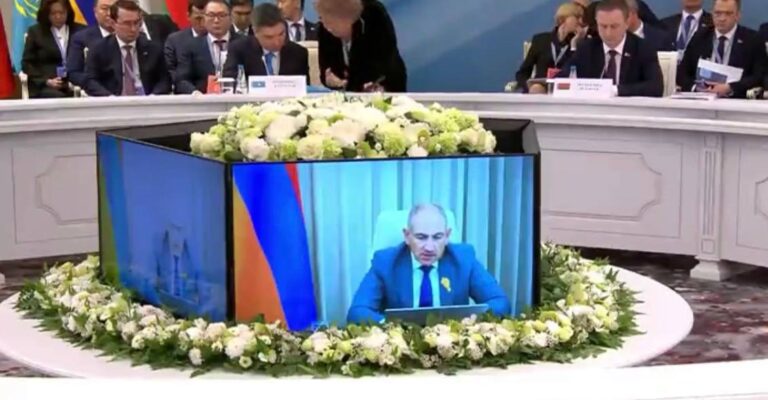

Armenian society must express its will through a referendum: Andrey Areshev
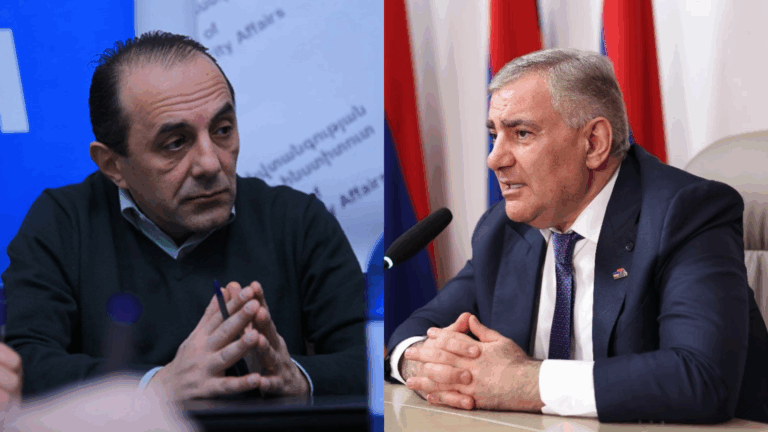
In an interview with Alpha News, Andrey Areshev, political analyst and expert at the Foundation for Strategic Culture, commented on the Supreme Eurasian Economic Council session, Armenian-Russian relations, and the upcoming parliamentary elections in Armenia.
“The discussion of such matters was planned during the Supreme Eurasian Council session in Astana. A document was prepared and adopted, political in nature, but formal nonetheless, proposing that the Republic of Armenia hold a referendum on the matter. Vladimir Putin had made the same proposal earlier, and he reiterated it today. Even some Russian politicians are not holding back, because the issue has indeed taken on a rather acute character. It is very important that the Russian side is speaking in terms of figures and specific losses that Armenia will incur across various sectors of its economy if it continues its ideologically driven and pragmatism-free foreign policy course. We know that the law on initiating the process of unilateral accession to the EU is declaratory in nature, yet such statements pose a direct threat to the citizens of Armenia and entire sectors of its economy. Neither Europe nor Armenia’s immediate neighbors will be able to offset these losses. Armenia does not border the EU, but it does border Turkey and Azerbaijan, that too must be taken into account,” Areshev stressed.
Should Pashinyan win the elections, he may present the results as a kind of referendum, Areshev noted, commenting on the EAEU leaders’ proposal to hold a national referendum in Armenia.
“The idea of a referendum will, in my view, be positively received by Armenian society, which will once again reflect on where it is being led and what the consequences might be. Pashinyan will most likely try to present the election results as a kind of referendum, but a firm decision has been made in Moscow: he will have to choose either he breaks with Russia or he breaks his commitments to European partners. I have always advocated constructive engagement through intergovernmental commissions, consultations, and mechanisms that allow contentious issues to be resolved in a working manner rather than being thrust into the public domain in a scandalous format. Moscow has always been oriented toward constructive dialogue, but we see that in Yerevan, possibly under the influence of external handlers, a different choice is being made. Since dialogue is being conducted not only with the EU but also with Britain, we recall the recent strategic partnership agreements, all of this shows that Armenia’s vector is shifting,” the expert said.
According to Areshev, Armenia’s current authorities may have certain agreements with Azerbaijan and Turkey regarding energy resources.
“I do not rule out that there may be certain agreements and symbolic steps related to increased cross-border engagement between Azerbaijan and Armenia, as well as between Armenia and Turkey. There are formats for this: on one hand, the Interstate Commission on Delimitation and Demarcation of Borders, which recently held a session in Aghveran; on the other, business community contacts and the ongoing question of resuming Armenian-Turkish transport links. Ankara, as we know, sets firm political conditions, including the signing of a peace agreement between Armenia and Azerbaijan. But whatever steps are taken, I do not rule out that a gas pipeline may be commissioned and deliveries of Azerbaijani gas to Armenia may begin. However, it is clear that they will not be able to compensate for the full volume of gas the country currently receives,” the political analyst stressed.
 Now live