
Economic and political relations between Russia and Europe will sooner or later be restored: Kirill Dmitriev
Kirill Dmitriev, Special Representative of the President of the Russian Federation for Investment and Economic Cooperation with Foreign Countries and head of the Russian Direct Investment Fund (RDIF), spoke at the 19th Verona Eurasian Economic Forum in Istanbul. He stressed the importance of resuming economic cooperation between Russia and Europe amid the start of cooperation between the Russian Federation and the US. He also said Europe has no alternative to cooperating with Russia in energy if it is to get out of the fuel crisis.
“First, this forum is very important, because it has traditionally been a forum for dialogue between Russia and Europe. This dialogue continues, and you certainly saw the speech by Mr. Prodi, who gave a balanced assessment and in fact said that sooner or later economic and political relations between Russia and Europe will be restored anyway. So the dialogue, which continues with Europe as well, is certainly important.
As you saw, I also addressed European business, because if you look at the average businessman from Germany or Italy, what do they see? Their markets in Russia have effectively closed, so they have lost 20–30% of their turnover. Some of their stores were recently smashed up by migrants and protesters in France and Italy, and they are paying much higher energy costs simply because of the European Union’s wrong energy policy. As I said, all businesses in Europe are suffering from very high energy prices. This is the result of the attempt to abandon Russian energy. So any average businessman in Europe is suffering from the EU’s policy.
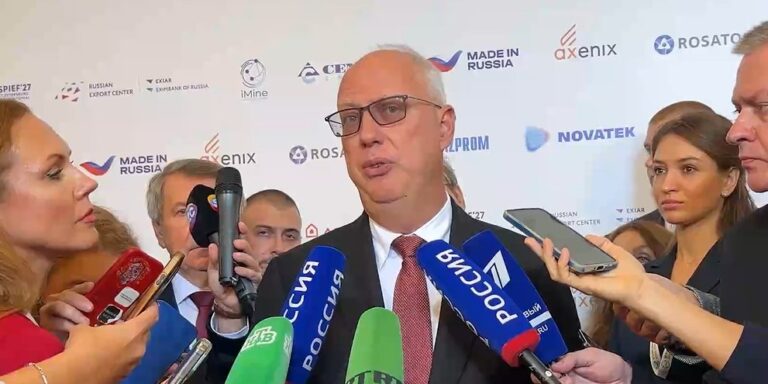
It is certainly important that representatives of European business are present here and see the opportunity to restore economic relations with Russia and to carry out business projects. Many businessmen from Europe have come up to us and thanked us for continuing the dialogue. They said: ‘We are with you, we will try to influence our government to change its approach, which is destroying our business.’ I think this is very important,” Dmitriev told journalists.
Dmitriev also spoke about the prospects for restoring Russia’s economic relations with the US and possible joint projects in the energy and technology sectors.
“For many people in Europe, this on the one hand caused surprise, and on the other prompted discussion: will Europe be left outside the dialogue and the economic restoration of relations? So we hear, and you saw this at the panel discussion, a great deal of discussion about how to make sure Europe is not left out of negotiations and economic deals. And, of course, we will watch how these processes and the discussion develop.
The president spoke yesterday, first of all, about fertilizers. And we see that Russian fertilizers and their supplies are extremely important for American farmers.
Yesterday I also spoke, for example, about a joint data center project, because Russia has the cheapest electricity for artificial intelligence in the world. And we see that we can cooperate in the technology sphere. And, of course, there are also energy projects in the Arctic and many others.
We believe that restoring economic relations is absolutely justified. And the enemies of economic cooperation between Russia and the US deliberately fear any projects. But we are breaking through this wall, including the media wall. Because any people who announce projects with Russia come under attack from biased media and so on. But through diesel, through fertilizers, through other projects, we are breaking through this media wall that attacks any Russian-American projects.
And we have a very clear argument: how can Europe object to a diesel deal when over the past four years it has itself bought 320 billion euros’ worth of energy from Russia?” Dmitriev said.
Dmitriev also added that Russia-US cooperation in the energy sector will continue and develop, expressing confidence that Europe could join it as well. He noted in particular that Russia could consider supplying diesel fuel to Europe if a request comes from the European side.
“I think that if the relevant requests come in, it is quite possible. And what matters here is that Europe is really suffering from extremely high energy costs. Many European businesses and citizens simply cannot afford such high costs. We see a fuel crisis in Europe, and it will only gather pace. So Europe is trying to rely on luck to get out of this fuel crisis. Europe has only one answer: partnership with Russia in energy,” Dmitriev concluded.
 Now live