
India sees Armenia as a market for its weapons: Aleksey Kupriyanov
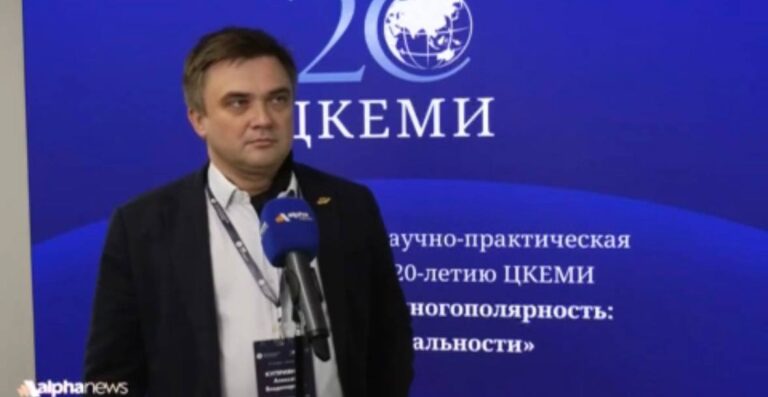
Aleksey Kupriyanov, Head of the Center for Indian Ocean Region Studies at the Primakov Institute of World Economy and International Relations of the Russian Academy of Sciences (IMEMO RAS), commented to Alpha News on India’s policy in the South Caucasus, New Delhi’s interest in Armenia and the prospects of the North-South transport corridor. He spoke on the sidelines of the international scientific and practical conference “Russia and the new multipolarity: from idea to reality,” held for the 20th anniversary of the Center for Comprehensive European and International Studies (CCEIS).
Speaking about India’s interest in the South Caucasus and its cooperation with Armenia, the expert noted that Armenia is of interest to India, among other things, as a market for Indian weapons. “First, in the situation that has developed in the South Caucasus because of the disagreements between Armenia and Azerbaijan, India is leaning toward Armenia, given that Azerbaijan is leaning toward Pakistan. Armenia interests India, above all, in terms of developing its tourism potential. That began back in the COVID era, when many Indians flew to Armenia as a cheap substitute for Europe, which they could not reach because of COVID restrictions.
And most importantly, it is a market for Indian weapons, because India is now actively developing its own weapons systems and localizing foreign ones, producing them under its own names and trying to enter this highly competitive global arms market, where it faces very tough competition from the United States, European manufacturers and Russia,” Kupriyanov said.
According to the expert, the Indian side is seeking to gain a foothold in the global arms market by offering relatively inexpensive high-tech solutions. “Russian competition has declined somewhat for now, but in any case, once the conflict is over, Russia will return with redoubled force and literally flood the market with its cheap equipment. And at this time, at this very moment, you have to manage to gain some kind of foothold. So the Indians are essentially offering fairly cheap high-tech solutions now, such as the Akash system. That is, first of all, air defense systems. They are now gradually starting to work on exporting their own drone systems, after they have saturated their own units in the Kashmir area and on the Indo-Chinese border. That is, they act as a kind of cheap substitute for Russian and Western equipment,” the expert noted.
Speaking about India’s interest in the North-South transport corridor and the impact of recent events around Iran on the project, the expert said that implementation of the corridor has effectively been put on pause.
“Right now practically the entire North-South corridor project has been put on pause for understandable reasons, because when Iranian territory is being struck or may be struck, pushing cargo through it is now mostly at one’s own risk,” Kupriyanov noted.
At the same time, he believes that the ongoing events are unlikely to seriously change India’s long-term approach to transport routes. “I don’t think the Indians will seriously change their approach, because they prefer not to put all their eggs in one basket and, as a rule, spread out their supply chains. That is, it is quite normal for them when, for example, some of the cargo goes through the Red Sea. At the same time, if the Red Sea is blocked for some reason, this cargo will go either around the Cape of Good Hope or, if there is a pause on the Iranian route, for example, they will quite readily push it through Iran. It is not in the Indians’ nature to fixate on one thing; they always try to diversify their options as much as possible,” Kupriyanov concluded.
 Now live