
It is hard to solve today’s global problems without Russia: Ivan Safranchuk
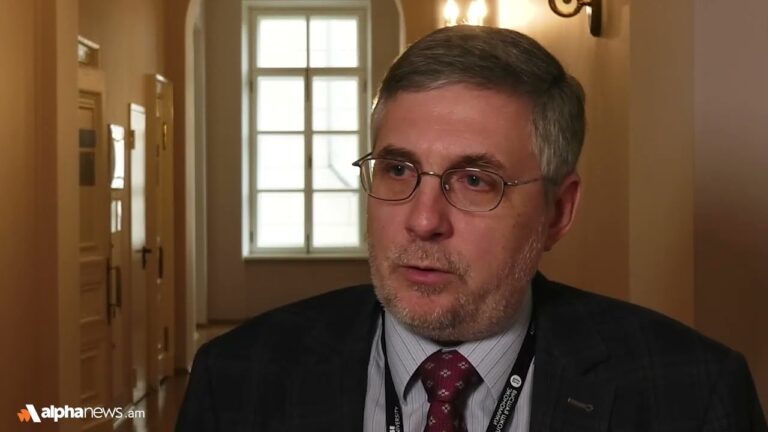
Ivan Safranchuk, professor at the Department of International Relations and Foreign Policy and leading research fellow at the Institute for International Studies at MGIMO University of the Russian Foreign Ministry, spoke to Alpha News on the sidelines of the international academic conference “Russia and the new multipolarity: from idea to reality,” held to mark the 20th anniversary of the Center for Comprehensive European and International Studies (CCEIS). He commented on the prospects for Russian-American relations and the further settlement of the Ukrainian conflict.
Speaking about Russian-American relations, the expert noted that from an expert standpoint, it is far more logical to normalize relations first and only then work on settling the Ukrainian crisis.
“The fact that Trump has agreed to open a dialogue is a relatively positive sign: some of his intuitive, instinctive impulses are right. Apparently, they are based on the understanding that it is quite difficult to resolve today’s global problems without Russia. Since Trump is also adding to the number of global problems, at least with the Iranian crisis, it is hard to deal with that problem without Russia’s active participation in international affairs. So, of course, he needs to shed the restrictions that the previous American administration placed on engagement with Russia, and which the European ‘war party’ continues to impose on him. But the path he chose toward normalizing relations with Russia is not optimal, because he made a settlement of the Ukrainian crisis a condition for normalizing Russian-American relations. Personally, I believe that from an expert standpoint, it is far more logical to normalize relations first and only then work on settling the Ukrainian crisis. That is why the sequence of actions he chose for normalizing relations, unfortunately, is not producing results.
If it is not possible to settle the Ukrainian crisis, then more emphasis should probably be placed on the overall normalization of Russian-American relations. I use the word ‘normalization’ deliberately, not ‘improvement’ of relations, but precisely normalization, or restoration, of relations. The current level of relations is simply abnormal for the modern world and for the norms of civilized communication. Strange and absurd restrictions on the work of diplomatic missions, the absence of direct air service and a significant part of the sanctions pressure are also strange and abnormal practices in modern international relations. The task has been formulated correctly, but the wrong formula was chosen to solve it. And, unfortunately, Trump has lost a whole year trying to find a solution within the wrong formula he chose,” Safranchuk said.
In the expert’s view, Trump is seeking to settle the Ukrainian crisis for domestic political reasons, but, in his assessment, a compromise in the form of a draw is impossible.
“Last year, Trump had a very serious trump card: ‘This is not my war, and I am not responsible for it.’ But now that he has been in the president’s office for almost two years, the phrase ‘not my war’ is becoming less and less convincing and adequate. That is why a reformatting has taken place this year. Previously, the aim of the Ukrainian crisis was to inflict a strategic defeat on Russia. This year it is obvious that both the American deep state and the European ‘war party’ are trying to use the Ukrainian crisis to inflict a strategic defeat on Trump personally. We will see whether they succeed or not.
Trump has domestic political motives for settling the Ukrainian crisis. He would be comfortable if this crisis ended in a draw. In my view, the intensity of the crisis is such that there will inevitably be a clearly defined losing side, and in that sense a draw is impossible. Trump is adapting to this idea very slowly, so I am not very optimistic about his further efforts to settle this crisis,” Safranchuk concluded.
 Now live