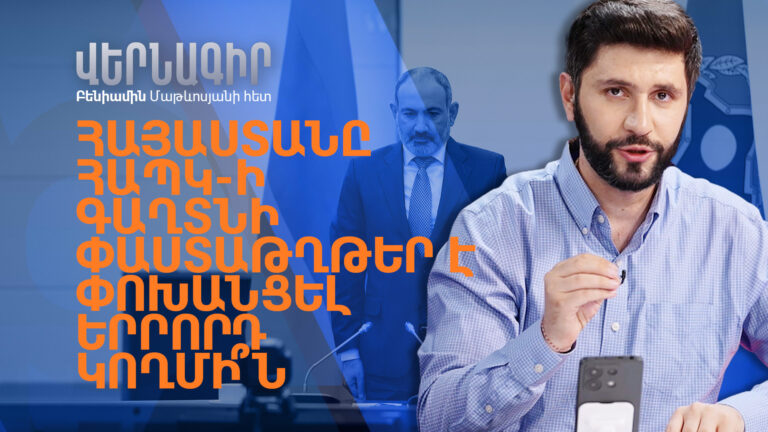

Beniamin Matevosyan: Did Armenia pass classified CSTO documents to a third party?
November 13 2026, 12:00
(Following the sensational statement by the Belarusian foreign minister)
The Collective Security Treaty Organization (CSTO) is a military-political bloc created for the collective defense of the sovereignty, territorial integrity and independence of its member states. In addition to responding militarily to external threats, the CSTO coordinates defense policy, holds joint exercises, develops the Collective Rapid Reaction Force and a peacekeeping contingent, and counters transnational crime, terrorism and drug trafficking. Membership gives member states significant military-technical advantages: the ability to buy modern weapons and military equipment at domestic, preferential prices, to train officers free of charge or on preferential terms at the allies’ specialized universities, and to use a unified air defense system and a shared intelligence and information space.
However, no military alliance can function effectively without a high level of mutual trust and the strictest observance of secrecy, since allies exchange classified data on the state of their armed forces, their defense plans and the operational situation. This is precisely why recent events surrounding Armenia’s participation in the organization have become unprecedented. Following the summit in Moscow, Dmitry Peskov, the Russian president’s press secretary, announced that the CSTO countries had decided to strip Yerevan of its voting rights and of the ability to appoint its representatives to senior posts allocated by quota. The grounds for this step were Armenia’s failure to meet its financial and statutory obligations for several years, which Sergey Lavrov, Russia’s foreign minister, had pointed out earlier, citing Article 25 of the organization’s charter.
Maxim Ryzhenkov, the foreign minister of Belarus, made the discussion far sharper and more sensational. Speaking on the Belarus 1 TV channel, he said it would be advisable to restrict Armenia’s access to classified CSTO documents and that he was confident this would happen. Calling Yerevan a “pseudo-ally,” the head of Belarus’s foreign ministry openly suggested that classified information could be used to the detriment of the states that continue to develop the bloc. Such rhetoric goes far beyond bureaucratic disputes over unpaid membership dues. It shows that trust in official Yerevan within the alliance has fallen to a critical level, and that Armenia’s CSTO allies may have serious concerns that the Armenian side previously passed on sensitive information to third countries outside the bloc’s security perimeter, or gave them access to it.
Suspicion of a possible leak or transfer of allies’ classified data is one of the gravest accusations in international politics and military diplomacy. Nevertheless, the vague wording from Minsk, which did not specify which documents were meant or whether there was concrete evidence of compromised data, leaves room for different interpretations. The situation is made worse by the lack of clear, detailed and substantive explanations from official Yerevan in response to the concerns raised. The Armenian side’s reaction was limited to an emotional Facebook post by Alen Simonyan, the secretary of the Security Council, in which he commented on the loss of voting rights with a remark about allies staying silent at critical moments for the country, completely avoiding the issue of information security.
This lack of clarity creates serious reputational risks for Yerevan on the international stage. In the world of high politics and intelligence alliances, a reputation as a reliable keeper of other people’s secrets is valued more highly than any declarations of friendship. If suspicions that Armenia is unable or unwilling to keep classified documents confidential do have grounds, a lack of trust in Armenia will arise not only among its current CSTO partners but also among the Western or regional players that Yerevan now sees as potential new security allies. No state will share advanced military technology and intelligence with a partner whose ability to keep secrets is in doubt.
Think about it…
 Now live