

Scientists confirm the origin of the Georgian and Caucasian Albanian alphabets from Armenian
April 01 2026, 20:36

The connections between different cultures around the world are sometimes found in the most unexpected places, including language. A new study has for the first time demonstrated such a connection quantitatively, writes naked-science. ru.
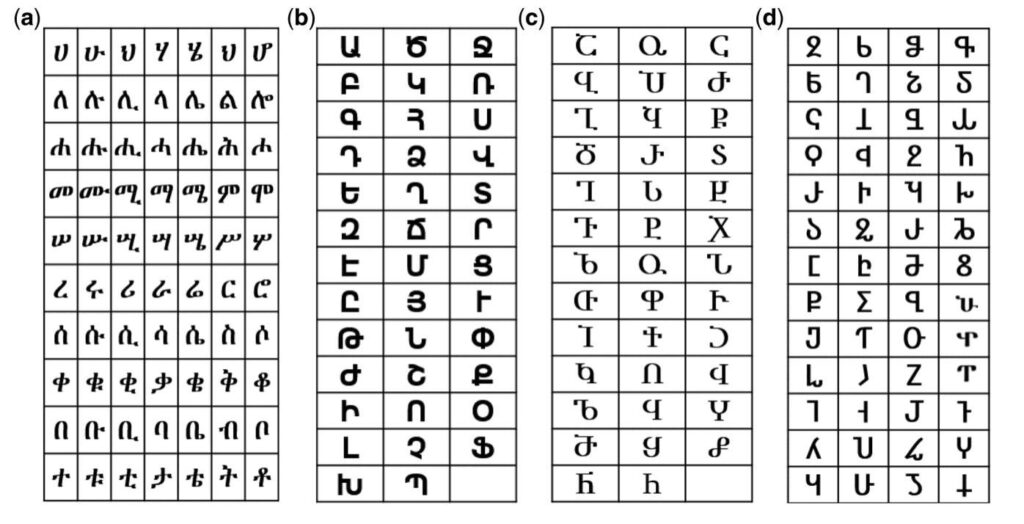
Using artificial intelligence as their tool, researchers at the University of San Diego (USA) have discovered a close resemblance between ancient writing systems from Africa and the Caucasus region of Eurasia. In particular, the findings, published in the journal Digital Scholarship in the Humanities, suggest that the Armenian alphabet may be more closely related in structure to the ancient Ethiopian writing system than linguists and historians had previously believed.
Scholars have long noted that certain Armenian, Georgian, and Caucasian Albanian letters bear a resemblance to those of the Ethiopian alphabet, also known as Ge’ez — a writing system developed in the Horn of Africa more than 1,600 years ago.
Until now, however, all judgments on this subject had been based on visual inspection of letters and the personal impressions of researchers. To eliminate the human factor and obtain an objective result, the authors of the new study trained a neural network on more than 28,000 images of Ethiopian letters, enabling it to learn the basic forms and patterns of that writing system. The program learned to recognize curves, straight lines, angles, and the overall structure of each letter in the Ethiopian alphabet, and then compared them with letters from the Armenian, Georgian, and Caucasian Albanian alphabets, assessing the degree of similarity.
Where the new study yielded a particularly interesting result was in quantitatively and indirectly confirming that the Georgian and Caucasian Albanian alphabets descended from Armenian. The fact that Armenian is closer in letterform to Ethiopian script than the other South Caucasian alphabets indicates that Armenian was the original Caucasian alphabet from which this style of writing spread across the region created by Mesrop Mashtots in the early fifth century. It appears that his writing system, with minor modifications, was adopted with relative ease by speakers of other languages in the region.
 Now live