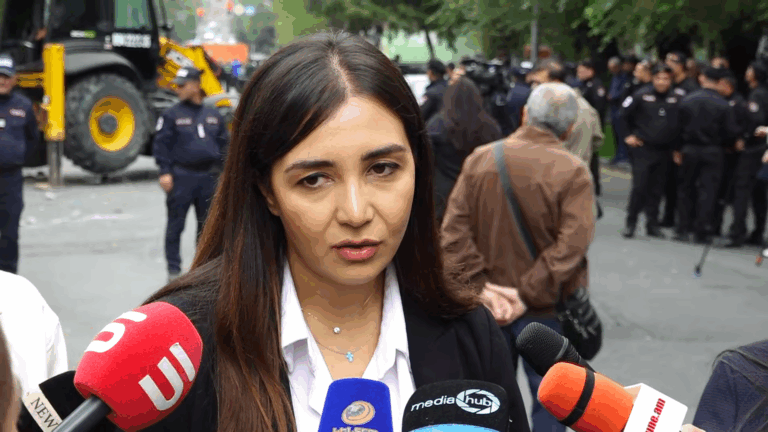

Beniamin Matevosyan: Pashinyan has no red lines – does the opposition understand this?
April 17 2026, 16:30
(What is replacing institutional methods of political struggle?)
In 2018, people took to the streets to address their socioeconomic problems, and also because they had no other institutional means of defending their rights, the democratic mechanisms for transferring power through elections had been destroyed (no matter how you voted, the Republican Party won). Today’s authorities are similarly working to undermine these institutions and practices: intimidating Armenian citizens with the specter of war, enlisting the EU’s support during elections, and carrying out mass detentions, including of women.
The shift toward a strategy of direct opposition suppression became clear after the latest high-profile arrests, which have finally erased any notion of moral limits on the part of law enforcement. The detention of Gohar Gumashyan, a member of the Strong Armenia party, shocked even a society grown accustomed to political repression: a nursing mother whose two-month-old infant requires constant care was cut off from her family under the pretext of combating “political charity.”
Asmik Amirzadyan, another activist from Samvel Karapetyan’s team, who is raising five adopted minor children, was detained under a similar scenario.
The accusations of vote-buying through humanitarian projects appear to be nothing more than a convenient cover for a systematic purge of the political field. When the state goes to war with mothers of large families, it is openly admitting its inability to compete with ideas and programs, and instead turns to a strategy of intimidating the most vulnerable segments of the population. It is also a clear indication that Nikol Pashinyan is well aware of his actual approval ratings and the difficulties he faces in the electoral process, which is why he has chosen to silence discontent through repression ahead of the elections.
Pashinyan understands perfectly well that his hold on power rests not on popular support, not on internal legitimacy, but on apathy, which tends to dissipate in the pre-election period. The destruction of institutional mechanisms for political struggle and rights protection: fair courts, independent investigative bodies, and transparent electoral processes, leaves the opposition facing a stark choice. In this reality, any attempt to play by the rules the authorities dictate is doomed to fail from the outset, since those in power change the rules as they go, turning charity into a crime and the defense of national interests into treason.
The authorities have no red lines, and every passing day confirms this. In the current situation, Samvel Karapetyan is becoming one of the central figures. His involvement in Armenia’s political process is not merely the arrival of another player, it is an existential challenge to the current regime, which explains Pashinyan’s nervousness. However, financial or media resources alone are no longer enough. Karapetyan must demonstrate through his actions that he is prepared for the scenario Pashinyan fears most. If the authorities move to formally bar his participation in politics or escalate the arrests of his supporters, the response must be “2018 in reverse.” This does not mean replicating the “velvet” playbook that ultimately led to the current catastrophe, but rather a genuine popular movement capable of institutionally returning power to the citizens.
The collective opposition and Samvel Karapetyan must send the authorities a clear signal: any attempt to push his party or any other political force outside the bounds of the law will result in the legitimacy of the authorities themselves being called into question, not in parliamentary chambers, but in the streets, as it was in 2018. The current process, unlike the events of eight years ago, must produce the opposite effect for Pashinyan, not a rotation of faces while preserving corrupt practices, but a complete overhaul of the political landscape across the halls of power.
The opposition must recognize: if the regime has no qualms about arresting nursing mothers, it is prepared to do anything to preserve itself. The only way to stop this is to demonstrate that the price of such actions will be fatal for the regime itself, and that the 2018 scenario could repeat itself, but this time as the final chapter in the political careers of those who once set it in motion. In this regard, it may be worth heeding the proposal put forward by Ishkhan Saghatelyan, a member of the National Assembly, who this week called for a joint opposition rally against Pashinyan’s repressive machine.
Think about it…
 Now live