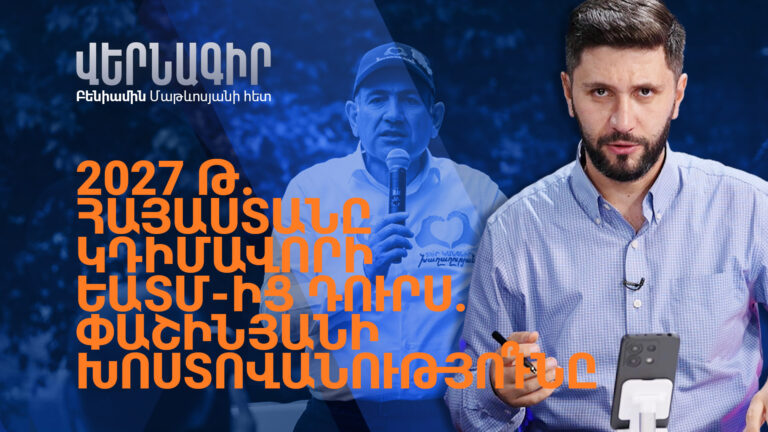

Beniamin Matevosyan: Armenia to enter 2027 outside the EAEU. An admission by Pashinyan?
October 13 2026, 19:00
(Key details of Pashinyan’s new interview)
The interview that Nikol Pashinyan, Prime Minister of Armenia, gave to Radio France International has shown clearly just how radically Yerevan’s foreign policy course is changing. The prime minister’s statement that holding a referendum on EU membership in 2026 is unrealistic because no formal application has been submitted sounds, at first glance, like a restraining factor. However, in the context of the preceding events and the conditions set by Moscow, these words take on an entirely different scale. In essence, postponing the referendum beyond 2026 directly contradicts the Kremlin’s position, which insisted that Yerevan decide as soon as possible between the Eurasian Economic Union and the EU. As a result, a scenario is emerging in which, by early 2027, Armenia may very likely find itself outside the EAEU.
Developments around the country’s integration choice accelerated after a law on starting the EU accession process was adopted in 2025 on the basis of a civic initiative, and in August Pashinyan announced that a formal application would soon be submitted. The Russian side’s position, voiced by Vladimir Putin, President of Russia, at a face-to-face meeting with the Armenian leader, was extremely clear: it is impossible to combine membership in two economic blocs pulling in different directions, and legislative steps toward rapprochement with the EU de facto launch the procedure of leaving the EAEU.
Moscow’s call for an urgent plebiscite was aimed at fixing the status quo and forcing Yerevan to make a final choice. By stating that the country is not ready to hold a referendum before the end of the year and pointing to the need to carry out an extensive reform program, Pashinyan is in effect rejecting the accelerated scenario proposed by Moscow, which inevitably leads to a growing institutional and economic rift with Eurasian structures.
The most noteworthy and meaningful aspect of the interview with French journalists was the prime minister’s acknowledgment of possible configurations of the country’s future. For the first time, Pashinyan openly formulated the concept that Armenia may find itself in a position where it is no longer a member of the EAEU but has not yet become part of the EU. The task he set out, to give the people the opportunity to decide whether to remain in the EAEU, join the EU, or belong to neither union, points to the authorities’ readiness for a period of integration vacuum. The Armenian leadership understands that meeting European standards is a lengthy process, and that Brussels’ own readiness for enlargement depends on the geopolitical situation. At the same time, Moscow has repeatedly stated that it is not ready to pay for “Armenia’s European bridges,” which puts Yerevan at a financial and transformational crossroads.
The statement about readiness to exist outside the traditional blocs opens a broad field for expert discussion about the future security architecture and economic orientation of the Republic of Armenia. On the one hand, this approach can be read as a sober acknowledgment of the limits of European prospects in the short term and of the high price to be paid for leaving the Eurasian market. On the other hand, the carefully calibrated wording about a “third path” may serve as an announcement of deeper processes linked to the country’s forced and gradual integration into the Turkic world and the reformatting of the entire regional logistics of the South Caucasus. One thing is clear: the Armenian leadership’s attempt to solve “unsolvable equations” and balance between the West and Russia is bringing the country to a turning point, where 2027 may become the start of an entirely new chapter in its foreign policy.
Think about it…
 Now live