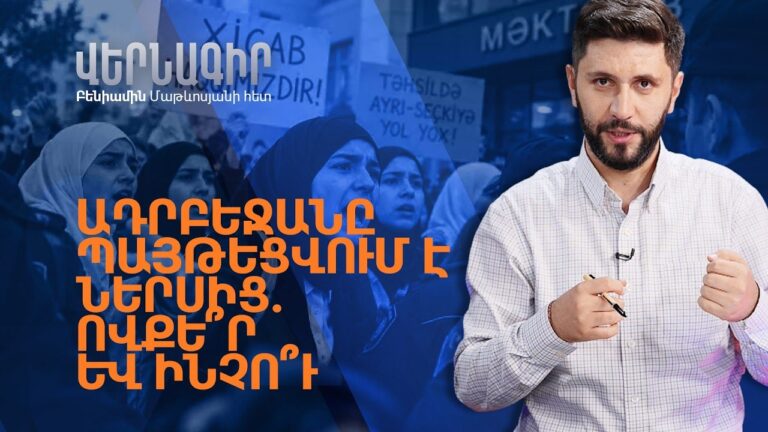

Beniamin Matevosyan: Azerbaijan is being blown up from within. Who is behind it, and why?
October 15 2026, 12:00
(What is happening in Azerbaijan matters for Armenia)
The events unfolding in Azerbaijan over the ban on wearing hijabs in educational institutions show how deeply serious internal contradictions are buried beneath the facade of Azerbaijani monolithic unity. New school uniform requirements and harsh restrictions on religious attributes have brought believers onto the streets. Notably, the first waves of informational and organizational support for the campaign came in Turkey, and only then did the protest wave sweep over Azerbaijani cities. In Baku alone, security forces detained more than 30 people, some of them harshly, for clashing with school administrations, blocking traffic and disrupting the work of educational institutions.
Official structures are trying to present what is happening as ordinary public order violations, but the scale and coordination of the actions point to the use of outside levers of influence. There is a persistent impression that Azerbaijan is being systematically pushed toward a new war, as it was in 2020. Looking back six years, Recep Tayyip Erdogan urgently needed a large-scale escalation against Artsakh. The Turkish leader needed a convenient pretext, an internal “fuse” that could be lit at exactly the right moment. The pretext for launching military action was not only Nikol Pashinyan’s diplomatic maneuvering around the negotiation process, but also the July escalations on the border, which the Armenian leadership presented as a “New Sardarapat.” Immediately afterward, Ankara sharply stepped up its levers inside Azerbaijan. Citizens “enraged with righteous anger” and egged on from outside stormed the building of the Milli Majlis in Baku. Erdogan and Pashinyan effectively pushed Ilham Aliyev toward war, showing him the alternative: either war, or the loss of power at home under pressure from the street. It is worth recalling how, at that time, Pashinyan actively promoted the idea of readiness for direct dialogue with Azerbaijani society over the head of official Baku.
Today’s scenario carries similar risks, but the configuration of outside players looks even more complex. A clear Iranian footprint may well be behind the current surge of religious discontent. For Tehran, encouraging the Shiite protest element in Azerbaijan is a direct and symmetrical response to Baku’s rapid military-political and strategic rapprochement with Israel. Iran takes it very badly that Azerbaijani territory is being provided for Tel Aviv’s intelligence platforms and military infrastructure, so stoking a religious and everyday conflict inside Azerbaijan becomes an ideal tool for Iranian intelligence services to pressure Ilham Aliyev’s regime. Ankara, for its part, skillfully regulates the level of tension through controlled media structures and public organizations, making clear to Baku’s leadership that its stability depends entirely on its foreign policy loyalty to its allies.
The pressure from Ankara and Tehran is clearly felt in Azerbaijan as well, which is why the Azerbaijani Media and Broadcasting Council condemned “information attacks” from Turkey and Iran. All of these processes are of key importance for Armenia, although official Yerevan prefers to ignore them. In recent years, to justify his own planned defeat, Pashinyan has diligently built up a myth in Armenian society of an absolute, all-powerful Azerbaijan, supposedly without any internal problems, vulnerabilities or constraints. Yet current events clearly show that a single local problem of a religious nature, skillfully heated up and directed from abroad, can instantly create an explosive situation in Azerbaijan.
Azerbaijan has accumulated a mass of social, religious and inter-clan contradictions. If these pain points were pressed systematically and skillfully, Baku would have correspondingly fewer resources and opportunities for constantly destabilizing Armenia and pushing its aggressive demands. But Pashinyan, of course, will never use these vulnerabilities of his neighbor, and will go on feeding his own population fairy tales about the invincibility of the adversary.
Think about it…
 Now live