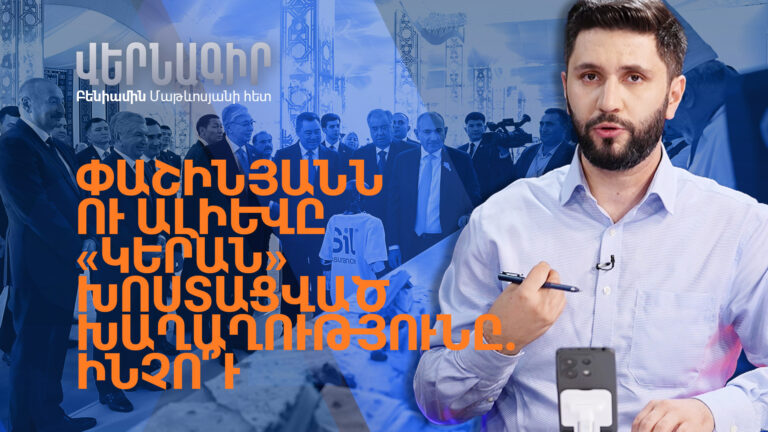

Beniamin Matevosyan: Pashinyan and Aliyev “ate up” the peace promised to Armenia. Why?
October 20 2026, 19:00
(Why is Nikol Pashinyan talking about peace only by 2031?)
The statement by Nikol Pashinyan, prime minister of Armenia, on his intention to sign and ratify a peace treaty with Azerbaijan only by 2031 was bound to have the effect of an exploding bomb, as it completely destroyed the informational and political narrative that the government had built. Previously, the entire pre-election logic of the authorities and the public rhetoric of official Yerevan were built on the thesis that “the long-awaited document is literally lying on the table and will be settled very soon.” True, no deadlines for signing were clearly stated, but the elections were presented as the final push toward peace, and citizens were urged to “stand up in defense of peace.”
It was believed that the sides had entered the home stretch, especially after the “historic peace summit held on August 8, 2025.” However, shifting the key benchmark straight to a five-year horizon throws the situation back to September 27, 2020, when talk of peace was least possible. True, six years ago the negotiations took place under exploding bombs, but the current “calm on the line of contact” does not change the fundamental reality: Baku’s aim of imposing total capitulation on Armenia.
Such a radical shift in deadlines clearly indicates that the real process has reached a dead end, and that Baku’s strategy toward Armenia is built on an entirely pragmatic and tough logic. Baku understands perfectly well that there is simply no point in binding itself with legally binding agreements and international guarantees as long as the current authorities of the Republic of Armenia are ready to make constant concessions under the threat of escalation. Why take responsibility for restraining its own ambitions and fixing final borders if constant pressure on Yerevan brings regular dividends? As a result, the Azerbaijani side keeps putting forward ever new conditions, while stretching out time and “feeding Armenian society promises” on the question of concluding the long-awaited pact.
Formally, Baku’s main and public demand remained a change to Armenia’s Constitution, from whose text the Azerbaijani side demands the removal of “any hints of territorial claims.” Earlier, representatives of the ruling party stated their readiness to go to a referendum and to negotiate with the opposition on amending the basic law. However, Pashinyan is in no hurry to implement this scenario through a vote. The reason is that the constitutional issue has become only the tip of the iceberg, behind which lies a far more substantial package of conditions. Baku seeks to obtain the fullest possible set of concessions: the transfer of enclaves, delimitation on its own terms, a strict limit on the size and equipment of the Armenian army, the resettlement of Azerbaijanis, and the creation of a corridor link through Syunik. At the same time, the Azerbaijani leadership expects to get all this essentially unilaterally, avoiding any formal obligations that could constrain its future actions.
The internal situation in Armenia also gives Baku convenient pretexts to drag out the process. External observers and neighbors note internal instability, the fragmentation of society, the marginalization of intellectual resources and harsh pressure on the opposition. The presence of opposition figures in prisons and the absence of broad public consensus become a clear argument for Baku: the country has no stable internal peace, so there is no point in rushing to sign the final document. Under these conditions, the Azerbaijani side constantly updates its list of grievances, regularly changing the parameters of the discussions, whether the issue is enclaves or the settlement of customs regimes.
Official Yerevan, for its part, has become a hostage of its own line of conduct, in which the only trump card left is intimidating rhetoric toward its own population. The authorities convey a simple message to society: if you do not agree to the current terms and to the rational doubts raised about the sustainability of the current arrangement, the only alternative will be a new war. Ultimately, this dynamic leads to the real peace that was promised to the citizens of Armenia for so long being, in effect, liquidated. Through their joint actions and the drawing out of the process, Aliyev and Pashinyan “ate up” the very peace treaty that had been promised, replacing it with an endless cycle of new concessions and vague promises on the horizon of 2031.
Think about it…
 Now live