
“Lazarev Club” session held in Moscow on “Armenia and Russia in a changing world: civilizational choice and future scenarios”
April 29 2026, 11:40
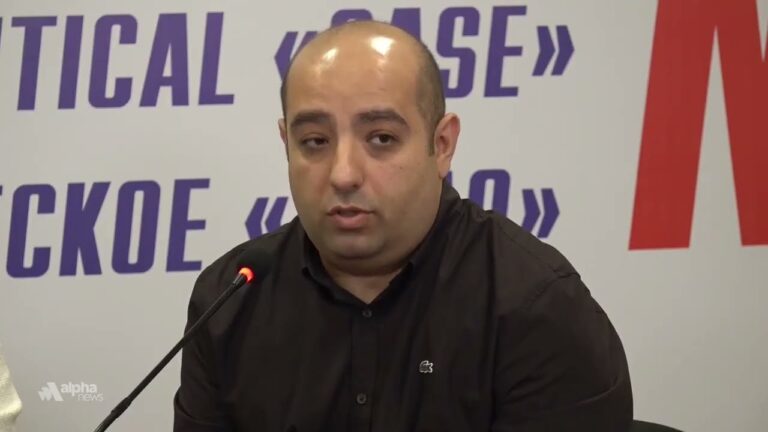
The seventh session of the International Russian-Armenian “Lazarev Club” took place in Moscow at the MonArch Hotel. The session was devoted to the theme “Armenia and Russia in a changing world: civilizational choice and future scenarios,” and opened with a blessing from Archbishop Ezras Nersisyan, Primate of the Russian and Nakhchivan Diocese of the Armenian Apostolic Church.
The gathering focused on discussing the current state of Armenian-Russian relations in the fields of politics, economics, and culture. Leading politicians and public figures, experts and scholars, as well as cultural figures from Russia and Armenia took part in the discussion.
Konstantin Zatulin, Deputy Chairman of the Russian State Duma Committee on CIS Affairs, Eurasian Integration and Relations with Compatriots and coordinator of the Lazarev Club council, spoke out about what he described as an assault on freedom of conscience and repression against the Armenian Apostolic Church in Armenia.
“The Armenian authorities are waging a relentless assault on freedom of conscience, on the rights of believers, and on the Armenian Apostolic Church, which is being subjected to repression. Whatever else we discuss today, I believe we are obliged to reflect in our final document our position on the fact that the oldest Christian church in the world is today being subjected to political persecution, and that the ruling party, Civil Contract, heading into elections, has incorporated into its platform documents further measures targeting the leadership of the Armenian Apostolic Church. In effect, the authorities in Armenia have declared war on the Church,” Zatulin said in his opening remarks.
The session also featured a video address by Robert Kocharyan, Armenia’s second president, who stated that Armenian-Russian relations are currently under serious threat.
“Armenian-Russian relations are today under serious threat. They have become hostage to the global confrontation between Russia and the West, driven by the painful process of forming a multipolar world. It is clear that neither the EU nor the United States has fundamental interests in the South Caucasus rather, pushing Russia out is seen as one element of weakening it. It is equally clear that the resulting vacancy will be filled by Turkey, and all of this is being done through the hands of puppet Armenians willing to sacrifice their country’s security for personal gain. In turbulent geopolitical times, when the rule of law has been replaced by the law of force, artificially distancing oneself from the most powerful state in the region is simply foolish, irresponsible, and extremely dangerous. And when you factor in the depth of Armenia’s economic ties with Russia, what is happening can only be called an act of sabotage against one’s own people,” Kocharyan said.
Those gathered exchanged views on possible future scenarios for Armenia and Russia. In particular, Nikolai Silaev, a research fellow at the MGIMO Institute for International Studies under the Russian Ministry of Foreign Affairs, addressed the Armenian authorities’ strategy of distancing the country from Russia.
“Many of the decisions being made in Armenia are made impulsively and in the grip of emotion. Moreover, when these decisions are made, they are often guided by ideological constructs or rather, fantasies. It is now clear that the goal of the current authorities is a gradual departure from Russia,” Silaev said.
In closing, Russian and Armenian participants of the Lazarev Club thanked one another for their openness and willingness to engage in dialogue, and agreed to continue their joint work toward strengthening bilateral ties.
 Now live