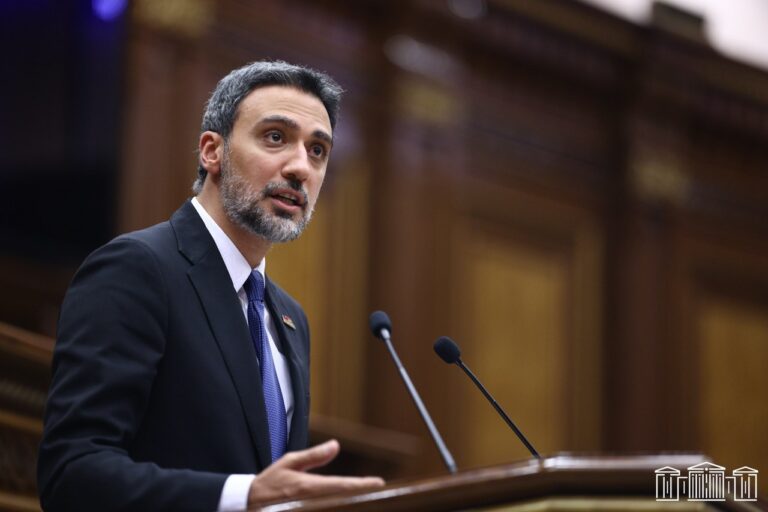

Armenia matters to the US as a pressure tool against Russia, not as a value in itself: Malek Dudakov
Malek Dudakov, a political scientist specializing in American affairs, shared his commentary with Alpha News on whether the US–Iran deal will lead to lasting peace, the role of Israel in the Middle East negotiating process, the significance of Armenia and the South Caucasus in US policy, and the fate of the TRIPP project.
According to the expert, there is no clear winner in the US–Iran standoff, but Iran holds a slight edge, having withstood the pressure and secured concessions from the US, including sanctions relief and discussions on unlocking assets.
“As we can see, in this confrontation between the United States and Iran, there is no obviously losing or obviously winning side. But on points, I think the advantage still lies with Iran, because it managed to hold out under very intense military and diplomatic pressure from the United States. Iran succeeded in inflicting significant damage on American military infrastructure across the Middle East, and also triggered a fairly serious energy crisis, including inside the US, which forced the Trump administration to make substantial concessions. What we are witnessing now, within the framework of the agreement being signed, includes sanctions relief, the unlocking of Iranian assets, and a promise to establish a future $300 billion fund for the reconstruction of the Iranian economy in a post-war format. Countries that are winning a conflict do not, as a rule, make such concessions. So one can say that the United States has, at least in part, given ground. Through these steps, they are essentially compelling and incentivizing Iran to, first, unblock the Strait of Hormuz, and second, de-escalate the situation on all fronts.
At the same time, this agreement is of course deeply unpopular with hawks in Washington and with the Israeli lobby. We can see how actively Israel is torpedoing any attempts at a negotiating process, the escalation in Lebanon is a vivid example of that. At the very last moment the deal came to the brink of collapse: the American delegation will most likely not reach Switzerland on Friday, though it will probably arrive eventually, just later.
This is connected to very harsh criticism of Israel’s actions from the Iranian delegation. So right now, as they say, the ball is in the United States’ court. They need to demonstrate that they are capable of pressuring Israel, and Netanyahu and his war cabinet personally, and of compelling Israel to agree to at least a temporary de-escalation on the Lebanese front. If that happens and the deal is signed, Trump will have more time to address other matters, which, as we can see, he is actively striving for, including trying to put this failure on the Iranian track behind him. But so far he has not fully managed to do so,” Dudakov said.
In the political scientist’s view, attitudes toward Israel are noticeably worsening both globally and within the US, and this trend could lead future administrations to revisit their policy toward Israel – to Israel’s detriment.
“The way Trump is now calling Netanyahu and constantly shouting at him, it is clear that change is already happening before our eyes.
I would recall that for the first time in modern history, more than 60% of Americans have come to view Israel’s policies negatively. That is to say, the old pro-Israel consensus that once prevailed in American society is gradually becoming a thing of the past. Among Democrats, anti-Israel sentiment is of course very strong right now, but it is also beginning to surface among Republicans and independent voters. So I think Democrats will actively play this anti-Israel card both in the upcoming congressional elections, four months away, and in the next presidential race in 2028. And Israel understands that it has gone too far and that there is no way to pull back. So it is trying to resolve all of its security-related issues while it still has the opportunity to do so,” Dudakov noted.
He added that the war with Iran is extremely unpopular in American society, and support for it is now even lower than it was at the outset.
“All the public opinion polls coming out right now show that more than 70% of Americans consider the war with Iran a mistake and believe that a ceasefire should be concluded immediately on any terms, as long as the Strait of Hormuz is unblocked and fuel prices and inflation inside the United States can be brought down. That is the priority for the American economy, and no one wants to get drawn into a prolonged Middle Eastern campaign with an unclear outcome and heavy losses among American servicemen. So Trump will of course present this deal as a move toward public opinion and an attempt to exit the situation while at least partially saving face. But I am not sure Trump will succeed in that, because many people view this deal quite negatively as well. It is simply that its alternative, which is continuing the war, is even more unpopular, so one has to choose the lesser of two evils,” Dudakov said.
Speaking about the role Armenia and the broader South Caucasus region play for the United States, the expert noted that for Americans, Armenia matters as a tool of pressure on Russia and Iran, rather than as something of independent value.
“I think that while for Europe, for instance, the South Caucasus region is also important largely as a potential source of energy supplies, for example, from Azerbaijan, for the United States the South Caucasus region matters primarily from a geopolitical standpoint: as an opportunity to use it as a lever of pressure on Russia and Iran. Because we understand that the so-called ‘Trump corridor,’ proposed to the Armenian side not long ago, is largely an attempt to intensify economic, trade, and sanctions pressure on the Islamic Republic of Iran. So for Americans, Armenia matters primarily as an instrument, not as something of independent value in the eyes of the American elite. For that reason, I think the region will continue to receive attention, particularly while the situation with Iran remains unstable. And we can see that in relations between Russia and the US, a fairly complex standoff continues, even if it has not escalated into a hot phase the way it did under Biden. So attention to the South Caucasus and Armenia will be maintained, but the region will be viewed as an instrument, not as a value in itself,” Dudakov emphasized.
Speaking about the fate of the “Trump route” project after the next US elections, the expert noted that it may well never come to fruition.
“A great many of Trump’s foreign policy projects ultimately fail to materialize. It remains unclear where the investments will come from, how the implementation mechanisms will be structured, how American private military companies will be deployed there, and so on. There are an enormous number of delicate details involved. So if Trump’s domestic political battles in the US intensify, it will of course be considerably harder for him to devote attention to external projects, including the South Caucasus region,” Dudakov concluded.
 Now live