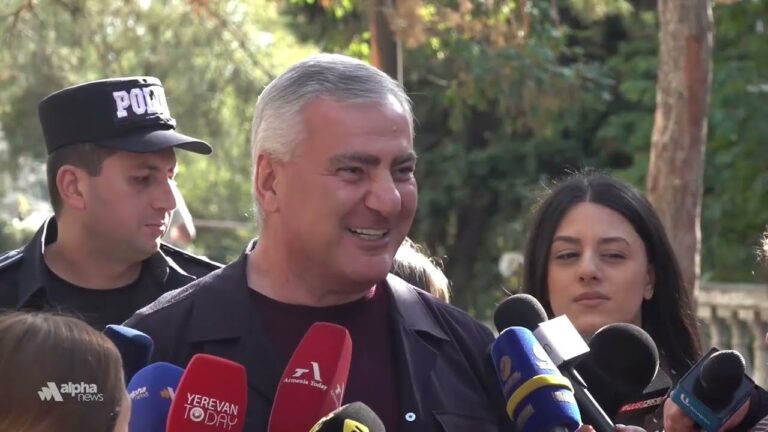

Beniamin Matevosyan: Pashinyan is attacking Putin’s friend
August 27 2026, 19:00
(What lies behind the criminal prosecution of Robert Kocharyan)
The latest criminal prosecution of Robert Kocharyan, Armenia’s second president, and his son Sedrak, initially went beyond the scope of a routine domestic political process. Another clear confirmation of Armenia’s leadership’s diplomatic and media strategy was Alen Simonyan’s first full‑fledged interview since his appointment as Secretary of the Security Council of the Republic of Armenia, which he decided to give to the Dozhd TV channel, an organization recognized in Russia as an undesirable one and a foreign agent. The choice of an information platform known for its sharply anti‑Kremlin stance turned out to be nothing other than a consistent continuation of Nikol Pashinyan’s line. This is a demonstrative step of the same order as the Armenian prime minister’s first phone call with Volodymyr Zelensky after his reappointment. Official Yerevan is deliberately raising the stakes by entering into open confrontation with the Kremlin.
Not only the platform itself attracted attention, but also the headline of the piece, which makes it clear that the Armenian side is well aware of Robert Kocharyan’s status as a close friend of Vladimir Putin. By giving such interviews, the Armenian authorities deliberately emphasize this factor, turning criminal cases against the opposition into a tool for foreign policy bargaining with Vladimir Putin.
Simonyan’s speech itself contained assessments about the undesirability of telephone contacts with the Kremlin “in the Kocharyan case,” which further revealed the essence of Pashinyan’s blackmail. Folk wisdom says: if you want to know the truth, ask a child. Alen Simonyan once again assumed the role of a child and revealed the essence of his political leader’s actions, blackmail aimed at forcing the Kremlin to enter into negotiations on Yerevan’s terms.
In essence, the pressure on Kocharyan amounts to the formation of a so-called exchange fund. By restricting the freedom of key opposition figures, Pashinyan hopes to obtain a valuable asset for subsequent bargaining with Russia. The Armenian authorities’ goal is to secure Moscow’s commitment to maintaining economic preferences, including free access for Armenian goods to the 150-million-strong Russian market and the continuation of the republic’s role as an important logistics and export hub. In practice, this amounts to an attempt to force the Russian leadership to finance and cover Yerevan’s geopolitical pivot towards the West.
The context of this stage of the confrontation between Yerevan and Moscow has been developing over a long period of time. Having not received the expected call and congratulations from the Russian president after the parliamentary elections, the Armenian prime minister tried to establish contact through Mikhail Mishustin, the Chairman of the Government of the Russian Federation, but encountered a tough and unyielding stance. Further telephone talks with Vladimir Putin, organized at the request of the Armenian side, merely confirmed the unchanging nature of Moscow’s approach to the current situation.
The expectation that the arrest of the second president of the Republic of Armenia would force the Kremlin to make concessions is fundamentally mistaken. From the Russian perspective, Yerevan’s current course appears questionable in terms of legitimacy and partnership obligations, so there is no direct pressure being exerted here. No proactive call from Moscow will follow in response to such actions.
Moreover, this tactic, as well as flirtations with the Kremlin’s opponents, will have the opposite effect. Pashinyan’s actions are provoking a development of events in which the future inevitable contact between the leaders of the two countries (which Yerevan will once again have to request) will take place under much stricter conditions. The list of demands from official Moscow under such a scenario will be significantly broader than the current set of issues.
This list will inevitably include not only the issue of ending the persecution of the opposition but also the question of the future political status of the parliamentary speaker, Alen Simonyan, whose public activity has gone too far.
Think about it…
 Now live