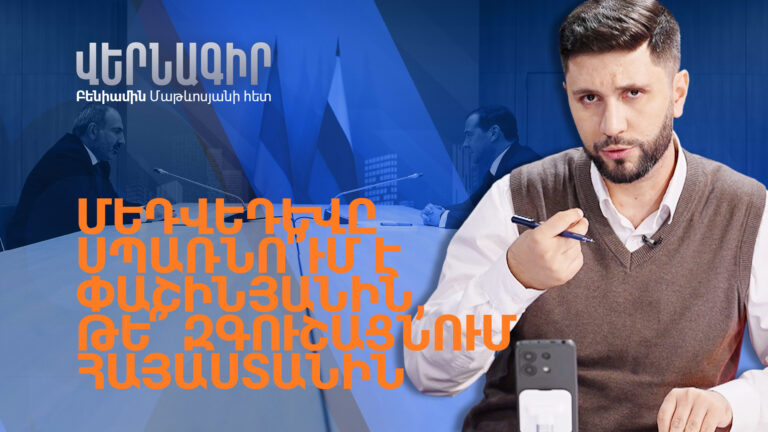

Beniamin Matevosyan: Is Medvedev threatening Pashinyan or warning Armenia?
October 06 2026, 19:00
(We are getting closer to the point of no return)
A statement by Dmitry Medvedev, deputy chairman of Russia’s Security Council and former president of Russia, made in an interview with Iranian state television and radio, has triggered a flurry of discussion in Yerevan. A comparison of Armenia with Ukraine from one of the key representatives of Russia’s ruling elite is a signal that cannot be ignored. The choice of media outlet itself points to a strategic calculation: broadcasting this point of view to an Iranian audience means the Kremlin is cementing a consensus among the region’s neighbors that the Armenian leadership is provoking a systemic crisis, with responsibility for the consequences falling entirely on Yerevan. This matters given the duality in Iran, where the spiritual and secular authorities often hold opposing views, and these theses from Medvedev amount to support for the position of the supreme leader and the IRGC.
After Medvedev’s words, the discussion in Armenia has centered on one question: was Medvedev threatening Pashinyan or warning Armenia? A historical precedent gives this situation special context. Dmitry Medvedev was the de facto last high-ranking official who, before the start of the SMO, clearly formulated the Russian elite’s attitude toward the Ukrainian authorities. His well-known programmatic article “Why contacts with the current Ukrainian leadership are meaningless” effectively drew a line under diplomatic attempts at dialogue between Moscow and Kyiv. Today’s comparison of Yerevan with Kyiv looks like a direct parallel, raising serious concern for the future of Armenian-Russian relations, which are rapidly approaching a dangerous point of no return.
However, the statement by the deputy chairman of Russia’s Security Council contains nuances that leave some room for maneuver. Medvedev stressed that outside forces are trying to split the South Caucasus and drive a wedge between Moscow and Yerevan, testing the strength of their kindred ties. This shows that the Kremlin is not yet placing absolute responsibility for the deterioration of relations solely on the Armenian side, blaming part of the problems on mechanisms operated from outside. Such a formula leaves a theoretical window for dialogue, if the vector of Yerevan’s foreign policy is open to adjustment.
In practice, though, the information and media space continues to heat up. Domestic propaganda and the actions of certain structures point to a course of further escalation. While diplomatic circles search for wording, media outlets broadcast stories that vividly demonstrate the severing of ties, as in the case of the Nairit plant, where Rosatom’s proposals are being rejected with argumentation.
Such an information backdrop in Armenia only underscores the deep systemic crisis. Armenia really does risk ending up at the epicenter of someone else’s geopolitical game, and time to prevent the worst-case scenario is rapidly running out.
Think about it…
 Now live