
EAEU countries’ report warns of risks to domestic markets after Armenia’s European integration: Vladimir Kireev
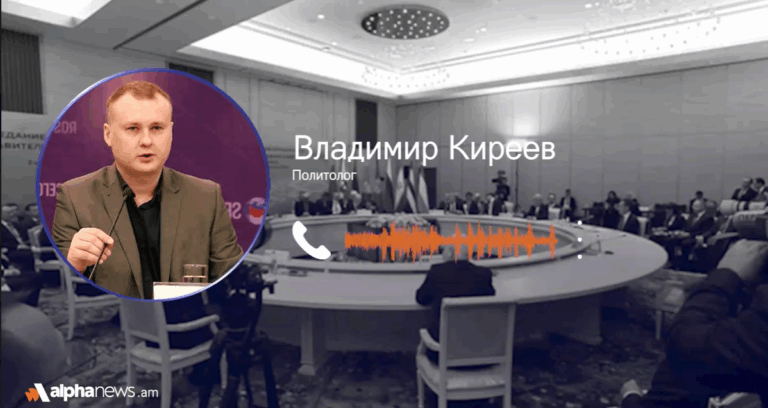
Vladimir Kireev, a political analyst, commented to Alpha News on the report by EAEU member states on the consequences of Armenia’s possible withdrawal from the organization and the Armenian authorities’ reaction to it. In his view, the report reflects the bloc countries’ desire to protect their own markets and economic interests, and, in the case of Russia and Belarus, to minimize political risks as well.
“The report by four member states of the Eurasian Economic Union on the consequences of Armenia joining the EU discusses the consequences for the Republic of Armenia and the EAEU, as well as the steps the member states of Eurasian economic cooperation will be forced to take once Armenia joins the EU. These measures are analytical in nature and driven by a desire to protect their markets, and in the case of the Russian Federation and the Republic of Belarus, also to minimize political risks. Armenia’s accession to the European Union would inevitably mean a breach of the terms of economic cooperation within the EAEU and would put the domestic markets of all its countries at risk. This is unacceptable, as it undermines these countries’ domestic economic interests, so they will be forced to protect their markets, and that is what this report is warning Armenia’s leadership about,” Kireev said.
According to the analyst, the reaction of Nikol Pashinyan, Prime Minister of Armenia, to the report stems from the fact that European integration has become part of the country’s domestic political discourse and confrontation.
“Pashinyan sees this as a blow to his own position. Perhaps that is indeed what it is, but the member states that produced this report hardly intended to interfere in Armenia’s internal affairs. The Russian Federation is, of course, interested in Armenia continuing to take part in the Eurasian integration initiative, because for Russia this is a matter of political influence. The other member states are most likely not particularly interested in cooperation with Armenia as such, so their position is driven primarily by the protection of their economic interests. I would remind you that all EAEU member states have had integration initiatives with the European Union in the past.
Kazakhstan and Kyrgyzstan still cooperate quite productively with the EU, so there is no basis to speak of any ill intent or hostility toward Armenia’s European choice, at least on the part of most of the report’s authors. Why does Pashinyan see it as a blow to his own position and his European integration initiative? Because it coincides with Armenia’s domestic agenda. The debate is about the choice now being made over which direction Armenia will develop in – toward European integration initiatives or Eurasian ones. Since this is a dividing line within Armenian society, and it coincides with domestic political discourse and conflict, the report is perceived as a blow directly to Pashinyan’s own position,” Vladimir Kireev concluded.
 Now live