

The long journey back to the wild: The return of Przewalski’s horses
November 04 2026, 13:30
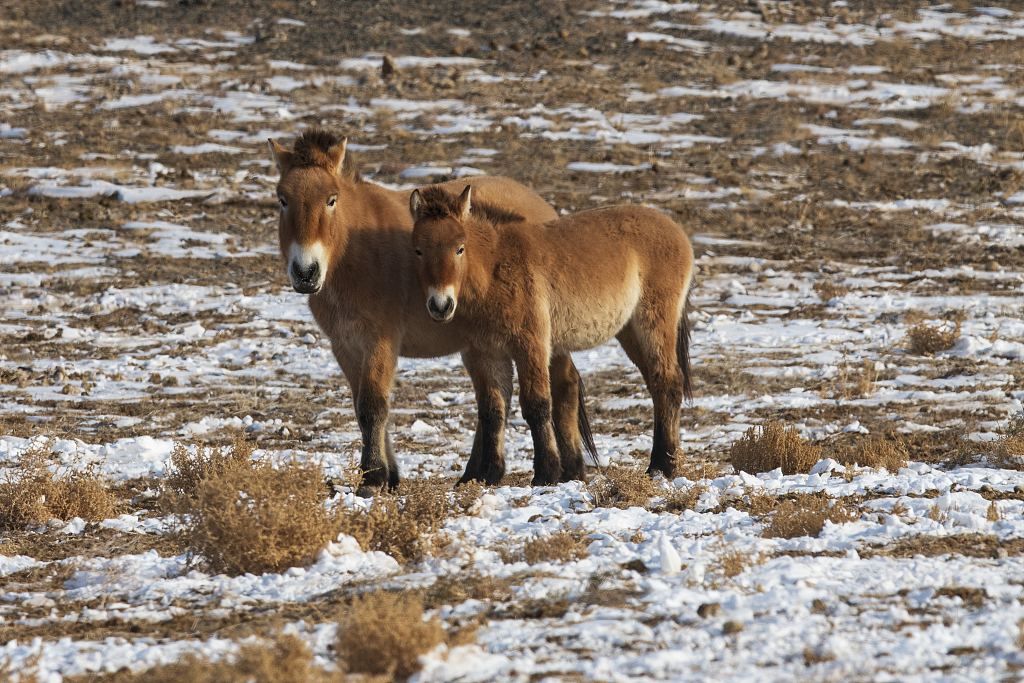
In the vast steppe of northwest China’s Xinjiang Uygur Autonomous Region, small
herds of Przewalski’s horses, the world’s last surviving wild horse species, roam the
Kalamaili Nature Reserve.
They search for food and water, navigate harsh weather and gallop freely across the
open land, sending clouds of dust into the air. The scene would have been impossible
to witness just two decades ago.
After disappearing from the wild in China by the 1970s, the horses have gradually
returned through four decades of conservation efforts, with their population growing
both in captivity and in the wild. The challenge now is shifting from rebuilding
population to ensuring their long-term survival.
Learning to live wild again
In 1985, China brought 11 Przewalski’s horses from Germany and the United
Kingdom to Xinjiang and established the Xinjiang Wild Horse Breeding and Research
Center to to help the species recover. The first foal was born at the center three years
later. By 2000, around 100 foals had been born there.
Keeping the horses alive and increasing their numbers was only the beginning. The
ultimate goal was to return them to the wild, where survival would depend on more
than human care.
In 2001, 27 Przewalski’s horses were released directly into the Kalamaili Nature
Reserve in the Junggar Basin. Without a preparatory period, the attempt proved
unsuccessful: three horses died after struggling to adapt to the sudden change. Harsh
weather, scarce food and water, and competition among stallions all posed challenges to survival.
Zhang Yanbao, who monitored the horses for seven years after their first release in
2001, remembers a story from the early days of the reintroduction.
A mare and her three offspring were released into the wild together. When the mare
died, her two daughters stayed close to their younger brother and protected him when
conflicts arose within the herd.
The young stallion, known as No. 147, faced another challenge as he matured.
Dominant stallions typically drive away younger males once they become rivals for
mates. But No. 147 remained in his herd longer than expected.
“His sisters shielded him whenever he needed and kept him close. With their support,
the young stallion grew strong and healthy. In the same year he was finally driven
from the herd, he succeeded in forming a group of his own with mares, which was a
remarkable achievement,” Zhang says.
The early setbacks helped shape a more gradual approach to reintroduction. Today,
the wild horses selected for release spend about six months to a year in a transitional
area covering roughly 20 square kilometers within the reserve. There, they learn to
find food and water, become familiar with the landscape and adjust to life with less
human assistance.
At the breeding center, the horses are fed twice a day. In the transitional area, food is
provided only once every three to five days, encouraging them to forage more
independently.
“Horses have very keen senses,” says Xue Jiannan, an animal science engineer at the
center. “Even before leaving the enclosure, they can detect where grass and water are
more abundant outside. They also seem to know how far they’ll need to travel to
reach those places.”
Even with this preparation, survival is not guaranteed. In winter, heavy snowfall can
bury grass beneath the snow, while insufficient snowfall can leave water sources
frozen. Rangers monitor the herds and intervene when necessary, providing food or
water during extreme weather and calling veterinarians when injuries or illnesses
threaten an animal’s life.
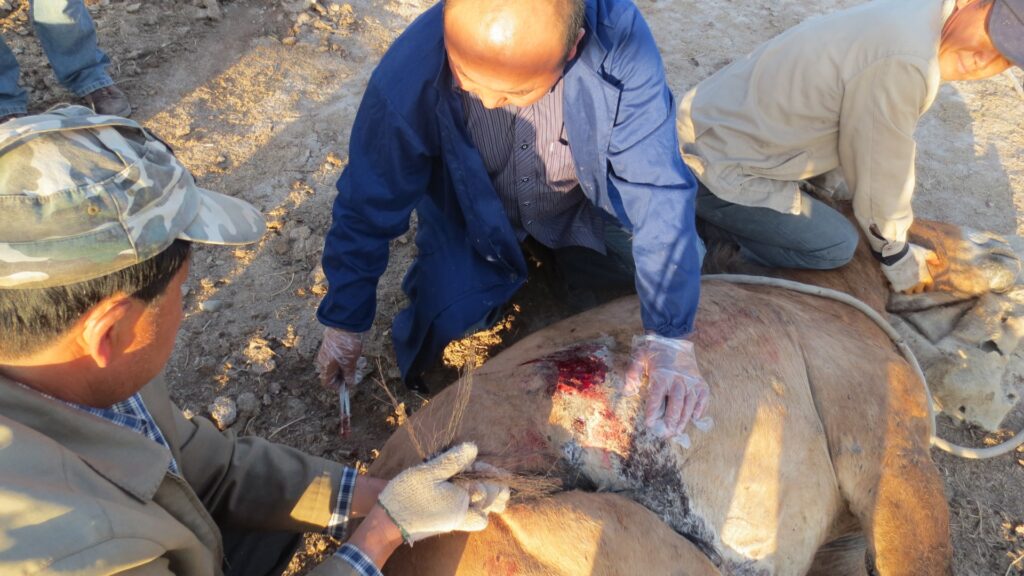
One particularly urgent case in 2016 remains vivid for Entemahan Azhanhan, a senior
veterinarian at the breeding center. Two stallions had fought fiercely, and one bit the
other’s genitals. The wound became infected, leaving the injured horse unable to walk
when it was found. Entemahan knew he had to act quickly.
“After administering anesthesia, I removed the infected tissue and stitched the wound.
For ten days, we treated him with topical medication, anti-inflammatory injections
and painkillers. Thankfully, the stallion survived and retained his ability to
reproduce,” he recalls.
The protection, however, is not to shield the horses from every danger, but to give
them the best chance of surviving on their own. By January 2026, about 180
Przewalski’s horses raised under human care had been returned to the wild in
Xinjiang.
The people behind the return
Protecting wild horses in the remote reserve can be as demanding as the conditions
the animals face.
In the early 2000s, monitoring equipment was limited and digital communications
unreliable in the Kalamaili Nature Reserve. Rangers often worked in pairs, tracking
animals across a vast landscape where wolves and other dangers were never far away.
Zhang Yanbao still remembers a summer afternoon when his vehicle broke down in
the reserve. He and his colleague could not repair it, and remaining there overnight
was not an option as there were many nocturnal predators.
They set off on foot.
“We ran for seven hours straight, without resting or drinking water,” Zhang says. “I
never imagined I could run for so long.”
They eventually reached a herdsman’s home at around 11 p.m., where they were
given food and water. After a short rest, they continued walking for another hour or
two before finally leaving the reserve.
Today, technology has made monitoring easier. The team uses camera traps, thermal
cameras, drones and GPS-enabled collars to track the horses’ movements. Collars
fitted to lead mares use China’s BeiDou satellite navigation system to help researchers
understand where herds spend their time.
Yet technology has not replaced the value of experience. Rangers still draw on years
of observation to locate the horses, assess their condition and decide when
intervention is necessary.
For Entemahan, the connection with the animals began long before he became a
veterinarian. Raised in a herdsman’s family, he grew up around horses and learned
from his parents how to care for them.
The center discourages staff from forming overly close relationships with the horses,
helping preserve their natural wariness of humans. For Entemahan, however, such
emotional attachment is difficult to avoid.
He remembers a night in 1999 when a mare gave birth to a foal that could not open
his eyes. As he tried to help the newborn, the mare became protective, biting and
kicking at him until he scrambled over a fence to escape injury.
Three or four years later, he took part in releasing that same mare into the wild. As the
team prepared to let her go, she lingered near their vehicle, seemingly reluctant to
leave.
Entemahan wondered whether she remembered the man who had helped her foal. The
moment stayed with him.
He had spent years caring for the animals, yet the purpose of that care was to prepare
them to live beyond it.
“I worried whether they could adapt, whether they would find enough food and water.
But at the same time, they are returning to their true home. It’s such a relief seeing
them run freely across the steppe,” Entemahan said.
Protecting a future in the wild
The return of Przewalski’s horses depends not only on preparing individual animals
but also on protecting the landscape they inhabit.
The Kalamaili Nature Reserve covers more than 14,000 square kilometers, spanning
Gobi and desert terrain. The region is rich in resources including coal, oil and gold.
Oil wells and mining sites once dotted parts of the landscape.
To improve conditions for wildlife, more than 280 oil wells had been sealed and the
land restored to grassland by the end of 2018, according to the conservation team.
Habitat restoration is only one part of the work. The population must also retain
enough genetic diversity to remain healthy over generations.
Between 1985 and 2005, the center introduced 24 Przewalski’s horses from countries
including the United States, the United Kingdom and Germany. These additions
helped broaden the genetic pool.
Today, breeding decisions are informed by DNA analysis of hair and fecal samples,
which allows researchers to assess how closely related potential breeding pairs are.
The center has reduced the coefficient of relatedness used in its breeding decisions
from around 0.2 to 0.01 or lower, according to Xue Jiannan.
The team is also studying artificial insemination, which could make it possible to
introduce new bloodlines without transporting live horses over long distances.
The effort reflects a shift in priorities. In the early years, increasing the population
was the main objective. Now, the focus is increasingly on maintaining genetic
diversity and ensuring that the horses can sustain healthy populations over time.
The progress has been substantial. China’s Przewalski’s horse population now
exceeds 900, accounting for about one-third of the global population. Roughly 560
live in Xinjiang, in both captive and wild settings.
The long-term goal is to establish a population capable of surviving and reproducing
in the wild, with minimal intervention.
For Xue Jiannan, seeing the wild horses in the nature reserve is a tangible sign of their
conservation efforts.
“When I see wild horses running freely on the steppe, or drinking at a water hole not
far from us, that’s when I truly understand the meaning of what we’ve done,” Xue
said.
His greatest hope is also the simplest: that one day the breeding and research center
will no longer be needed to protect an endangered species.
“That will be the moment we know our mission is complete and that we have done
our job well.”
Protecting biodiversity beyond Przewalski’s horses
The return of Przewalski’s horses to the wild is one example of the broader effort
required to protect biodiversity: restoring habitats, safeguarding threatened species
and ensuring that ecosystems can sustain life over the long term.
That challenge is also at the center of the 17 th meeting of the Conference of the Parties
to the Convention on Biological Diversity (COP17), being held in Yerevan, Armenia,
from October 19 to 30.
The conference marks the first global review of progress under the Kunming-
Montreal Global Biodiversity Framework, adopted in 2022, which sets 23 targets for
The review aims to assess how far countries have come and what more is
needed to meet their commitments.
Among the framework’s key goals is conserving at least 30% of the world’s land,
inland waters, coastal and marine areas by 2030. It also calls for urgent action to halt
human-induced extinctions, recover threatened species and reduce human-wildlife
conflict.
At the opening ceremony of the “China Corner” at COP17, China’s minister of
ecology and environment Huang Runqiu noted that despite growing international
commitment, progress remains insufficient to meet global biodiversity targets. He has
called on countries to take concrete action and pursue more transformative measures
to accelerate implementation.
The experience of Przewalski’s horses illustrates what such efforts require on the
ground. Reintroducing a species is only the beginning. Its long-term survival depends
on suitable habitats, continued monitoring and the ability to withstand the pressures of
life in the wild.
As countries work toward the 2030 biodiversity targets, the challenge is not simply to
make commitments, but to turn them into lasting results for wildlife and the
ecosystems on which all life depends.
Author: Chen Ziqi, a reporter from CGTN
 Now live