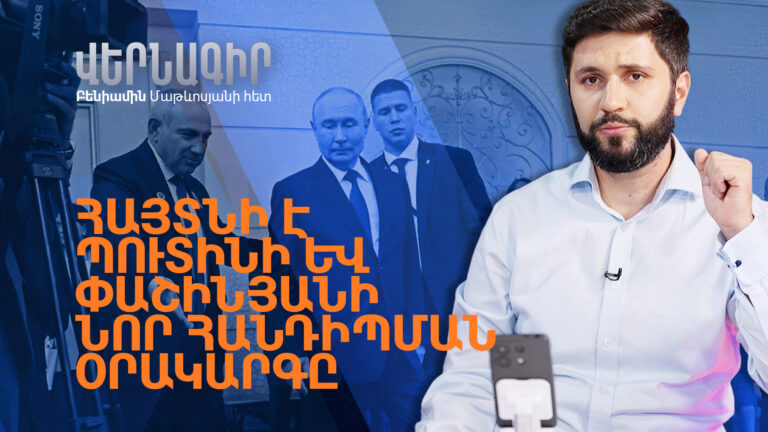

Beniamin Matevosyan: agenda of new Putin-Pashinyan meeting is known
September 08 2026, 19:00
(Visit to Moscow expected by the end of this year)
The upcoming visit of Prime Minister Nikol Pashinyan to Moscow, announced for before the end of this year, will become a defining stage for the future trajectory of Russian-Armenian relations. Dmitry Peskov, Press Secretary of the Russian President, confirmed that one of the main topics of talks between Russian President Vladimir Putin and Pashinyan will be the choice of the country’s development direction, as well as discussion of a possible referendum. The way the agenda is being framed shows that Moscow expects clear and transparent answers from Yerevan on key issues of bilateral cooperation that have been accumulating amid the Armenian leadership’s active drift from cooperation with Russia toward confrontation with Moscow.
For the Russian side, the priority set of issues is tied to economic and strategic presence in the region. First, ahead of the September visit to Yerevan by Alexey Likhachev, head of Rosatom, a decision on building a new nuclear power plant of Russian design is becoming a matter of principle. Amid discussions of possible alternatives in the form of small modular reactors from the US (an agreement on which was signed in February of this year), Moscow is offering gigawatt-scale projects, arguing this is justified by growing energy shortages driven by the rollout of data centers and artificial intelligence systems.
Second, a key aspect remains creating favorable conditions for Russian business to operate and ensuring guarantees for the safety of major infrastructure assets, including an end to attempts to revise the concession agreement under which the company SCR (South Caucasus Railway) manages the railways.
However, the actions of the Armenian leadership ahead of the planned visit point to a different direction of preparation for the meeting. Instead of seeking compromise solutions, Yerevan is taking steps to intensify the repressive apparatus and deepen its foreign-policy pivot. Domestically, a tightening of criminal prosecution against politicians oriented toward constructive dialogue with Russia cannot be ruled out, as well as the opening of new criminal cases against representatives of the opposition and the Armenian Apostolic Church.
On the foreign-policy track, Pashinyan is seeking to offset possible economic costs from the cooling of relations with Moscow through rapprochement with Brussels. The EU Council’s decision on temporary trade liberalization for a two-year period, covering roughly 80% of Armenian exports, is seen by Yerevan as a supportive step, although it does not guarantee direct financial assistance and contains strict safeguard clauses for the European market.
The rhetoric of Armenian authorities following the international meetings in Bishkek, and information campaigns in state media, demonstrate a lack of readiness for compromise. Public accusations against Russia, its President Putin, and allied structures point to an intention to continue the course toward the gradual squeezing out of Russia’s presence from the South Caucasus. Against this backdrop, the upcoming talks in Moscow will, in effect, confront Yerevan with the need to make a final choice, one on which not only the republic’s economic stability will depend, but the entire security system of the region.
At the same time, it is important to understand: if, as a result of the negotiations and the search for mutually beneficial solutions, all of Moscow’s demands are de facto fulfilled, this will not guarantee that Pashinyan becomes legitimate in the Kremlin’s eyes. Rather, it would mark the beginning of a process of changing Pashinyan’s political status. The phrase “resignation due to loss of trust” is, not coincidentally, quite common within Russian political realities.
Think about it…
 Now live