
The current authorities in Armenia are incapable of resolving existential challenges: French journalist
April 24 2026, 18:05
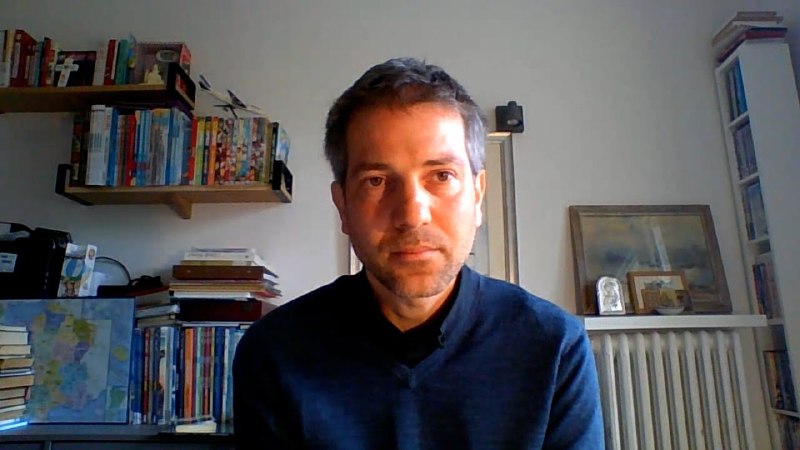
We are living through a period of unprecedented political upheaval and crisis. This is not only a political crisis in the narrow sense, but a deep crisis of trust, above all, mutual trust between the Armenian authorities and the Armenian Diaspora. This was stated to Alpha News by Tigran Yegavian, a French journalist and essayist.
“One gets the sense that we have reached a point of no return, where two trajectories of development are proving difficult to reconcile. On one hand, there is the course chosen by the Armenian government, oriented toward the normalization of relations with Turkey and Azerbaijan. On the other, there is the perception of Armenia as the bearer of a complex historical and civilizational identity, encompassing the experience of transnational existence. Ignoring this dimension inevitably deepens the rift between the state and the Diaspora. In this situation, we are confronted with a complex challenge, philosophical, political, and geostrategic, that touches on the very question of the survival and future of Armenian identity. I travel to Armenia frequently, I have many relatives there, and I understand that a gap exists both in the level of knowledge and in the understanding of each other’s reality. The Diaspora often does not grasp deeply enough the internal processes taking place in Armenia, while within Armenia itself there is a limited awareness of the diversity, resources, and potential of the Diaspora. Silence and apathy are the most accurate description of the current state of Armenian society. This is not simply passivity, but a deep social syndrome in which a significant portion of citizens identify neither with the authorities nor with the opposition. The majority finds itself in a position of waiting and watching, a kind of ‘third position,’ devoid of any real political expression. This state is accompanied by a sense of mounting social disintegration, a loss of bearings and of trust. The result is a risk of systemic collapse. At the root of the problem, to a large extent, lies the absence of a political force capable of offering society a substantive, unifying, and development-oriented agenda. The vacuum of meaning generates polarization: one part of society supports the current authorities, another opposes them, while the majority remains outside active participation. All of this stems from a lack of a culture of statehood, because Armenia is not yet a fully formed state. It is something hybrid with a transnational system, yet at the same time a very weak state, because the current Armenian state does not represent the entire nation in its fullness, and this makes the state far too weak. The people who govern it do not possess a statesman’s mindset. They have the mindset of a regime, and that is not the same thing,” the journalist said.
According to Yegavian, the current leadership of Armenia, and, in particular the course associated with Pashinyan, is in many respects populist in character.
“But the problem also lies in the fact that Armenia’s political institutions are not strong enough to withstand a transfer of power. Each time, a ‘blank slate’ is created. Everything from the past is rejected. An attempt is made to build something new, but without support, without a foundation. The result is a sense of groundlessness. And this is an extremely dangerous condition for a state. And when Pashinyan says, ‘If you are against me, you are against Armenia’, and the Armenian ambassador to France tells me, ‘If you criticize Pashinyan, you are criticizing Armenia’, I cannot accept or acknowledge that. Today we observe that the current leadership of Armenia, in particular, the course associated with Pashinyan, is in many respects populist in character. Populism in this context means the tendency to offer quick and convenient answers capable of satisfying public expectations, without touching on the deeper, existential questions. The absence of strategic depth and systemic analysis becomes a serious problem, especially given the challenges of the current moment. The role of the Diaspora is very important: it faces the task not only of making sense of the new paradigm, but of actively participating in the strengthening of cultural, educational, and academic institutions. Without systematic work in these areas, the risk of further fragmentation of the Armenian world becomes ever more tangible,” Yegavian noted.
 Now live